
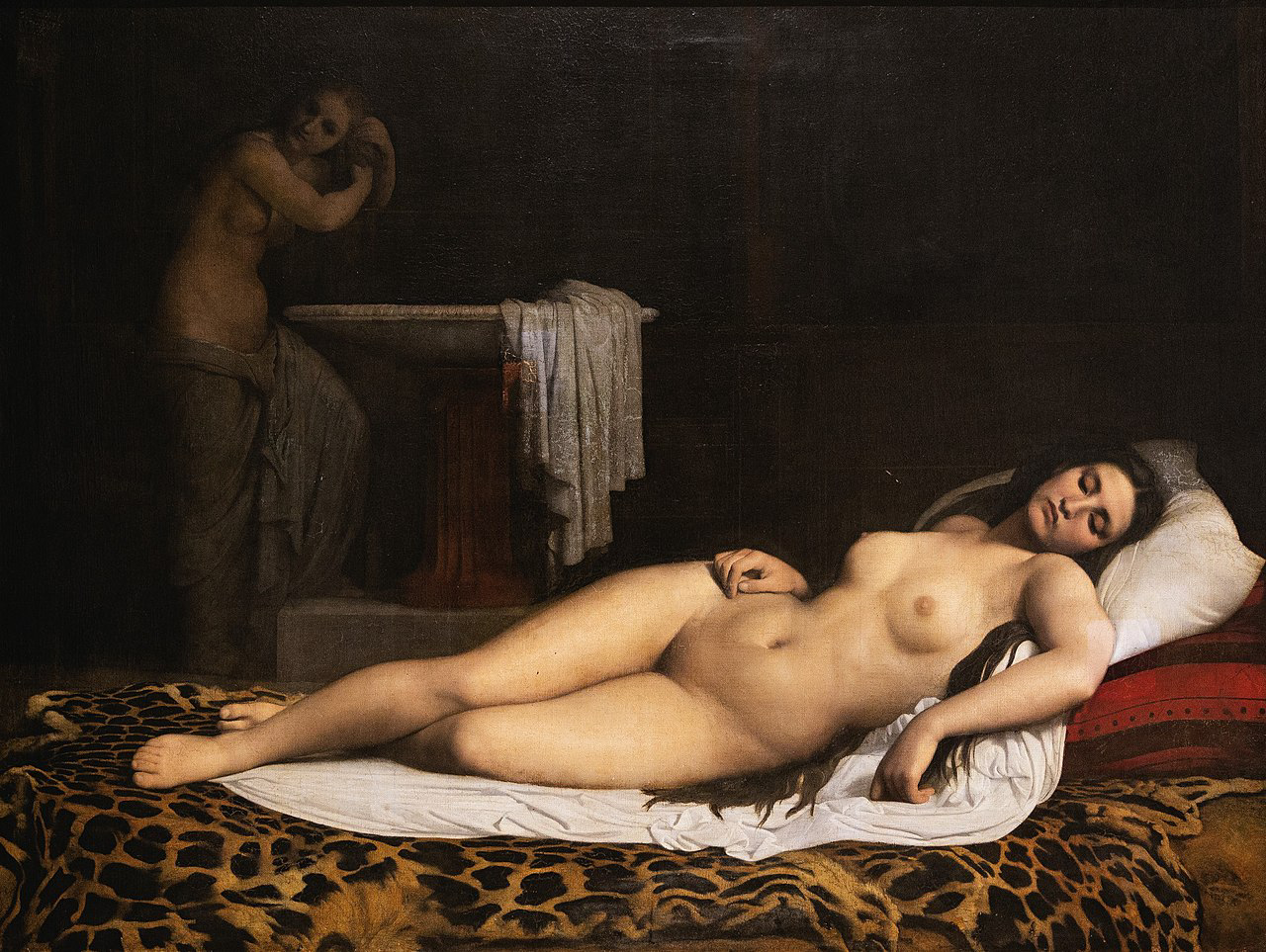

This is a mysterious painting, with—I have to admit—quite an erotic touch. When first encountering the painting, I misread the title as “The Obelisk”, but I didn’t (obviously) get that to add up. When I looked at the title again and spelt my way through it, I didn’t understand what an “odalisque” was. Could it be the female part of an obelisk, I wondered? As an obelisk is a tapering stone pillar, perhaps an odalisque would be a figure with more feminine features? Because femininity is displayed in abundance in the painting.
It took some time before I investigated the title further, and meanwhile I studied the painting. If we start at the back of the painting, we see a woman washing, or setting up, her hair. She is partly dressed and seems to be preoccupied with her thoughts. She is only partially illuminated, rendered with a greyish skin tone. The way she is draped from her waist down resembles the ancient Greek sculpture Venus de Milo; even the posture of her legs connects her to this momentous statue. The rest of the background is mostly black and brown; it looks like a wall, giving the impression that this is a sparsely decorated room.
In front of the painting, however, we see a gracious woman, lying—sleeping perhaps—nude on a sofa or a divan. She has extremely long hair; it lies beneath her, and it stretches all the way down to her thighs. She seems to be at rest, although her sleeping position does not look very comfortable. It looks almost as if she has chosen a posture for displaying her body and then trying to rest in that position. Her facial expression indicates, I think, that she is not resting peacefully; she seems to be constrained by something.
And indeed, when we look a bit closer at the title, it turns out that an odalisque, according to the Oxford Dictionary, is a
- a female slave or concubine in a harem, especially one in the seraglio of the Sultan of Turkey.
- an exotic, sexually attractive woman.
The word originated in late 17th-century France, from Turkish odalik, from oda ‘chamber’ and lik ‘function’.
And further, according to the same dictionary, a seraglio is
- the women's apartments (harem) in an Ottoman palace, the women inhabiting a seraglio or harem.
- a Turkish or Ottoman palace, especially the Sultan's court and government offices at Constantinople.
The woman is a slave, then, which might explain her strained facial expression. This might also explain the few decorative elements in the room; it looks more like a cell or a dungeon than a place one chooses to live. However, most of the harems where odalisques would reside—at least according to many of the other paintings with names that include the word “odalisque”—were overwhelmingly decorated, with tapestry, soft pillows, curtains and large pieces of cloth hanging from the roof. The woman (or women) in the picture above seem to be part of a quite different household, where objects of luxury are not a part.
However, the sparsely decorated room has the effect of enhancing the woman in the foreground, making her the sole point of interest. Her body is what our eyes are drawn towards, what we scrutinise, what we... well… desire. There is nothing much else to look at in the painting, but still, it seems enough. Her hand placed softly on her hip increases the erotic tension in the scene, and the fact that she is sleeping, or at least closing her eyes, adds to the notion of her being an "object", or a “commodity”.
The painting reinforces the Western fascination with the exotic and the other, and the harem setting often perpetuates stereotypes about the submissive and sexually available nature of women in the Middle East. This issue of otherness is, in fact, of crucial importance in such a painting. In order to legitimately depict women in this way, with obvious sensual and erotic undertones, it was imperative that the artist placed the motif in a context outside the established European culture. The fascination for the exotic Orient was founded, perhaps, at least partly, on a comprehension that the Oriental way of life was different from the European, the customs and traditions were different, and the role of the women was different. This subversive role of the women, apparently, became a legitimate theme to depict and investigate through painting and a way of moving the focus from the mythological Greek figures of the past to more contemporary situations. However, many of those who painted these kinds of themes had never been to the Orient and populated their paintings based on hearsay and information they received from others.
Looking through Papety's catalogue of paintings, I find The Odalisque differs significantly in terms of expression. Many of his other paintings seem a little "flat", or two-dimensional, uninspiring, I would say—at least to an untrained eye like mine—so it is curious that the rendering of the main motif in the painting above is so generous.
The painter
Dominique Louis Féréol Papety was born on June 12, 1815, in Marseille, France. He began his artistic education at a young age, studying under local artists before enrolling at the Ecole des Beaux-Arts in Paris. In 1833, at the juvenile age of 18, he exhibited his first work at the Paris Salon, which was a portrait of a friend.
Papety studied under the celebrated French painter Jean-Auguste-Dominique Ingres, who was known for his classical and historical subjects. Ingres had a significant influence on Papety’s work, particularly in terms of composition and use of colour. Papety’s early paintings were heavily inspired by Ingres, but he later developed his own style, which was marked by dramatic lighting and complex compositions.
Papety was also involved in theatre and designed sets and costumes for productions in Paris. He was particularly interested in the use of light in theatre and experimented with new lighting techniques to enhance the dramatic effect of the performances. His interest in theatre is evident in some of his paintings, which often feature theatrical lighting and dramatic poses.
Winning the 1836 Prix de Rome, from then until 1841 he stayed at the Villa Medici in Rome, igniting his lifelong interest in Greek and Roman art. He visited Greece in 1846 and 1847, and many of his later paintings show similarities with the French Neo-Grec style made popular by Jean-Léon Gérôme and others.
Papety’s interest in Orientalism, which was a popular theme among French artists in the 19th century, is evident in the painting above. The Odalisque was completed in 1839, at a time when the French fascination with the Middle East was at its peak. The painting was exhibited at the Paris Salon the same year, where it received critical acclaim and helped to establish Papety as a successful painter. The theme of the harem, which was a common subject in Orientalist art, was often used to depict the exotic and mysterious world of the Orient.
In 1846, Papety received a commission to decorate the ceiling of the Salle des Séances (boardrooms) in the Palais Bourbon in Paris. He created a series of frescoes depicting the history of France, but unfortunately, the frescoes were destroyed during the Paris Commune in 1871.
Despite his relatively short career, Papety was regarded as a talented artist and was well-respected by his contemporaries. He died of cholera on February 17, 1849, at the age of 33.