
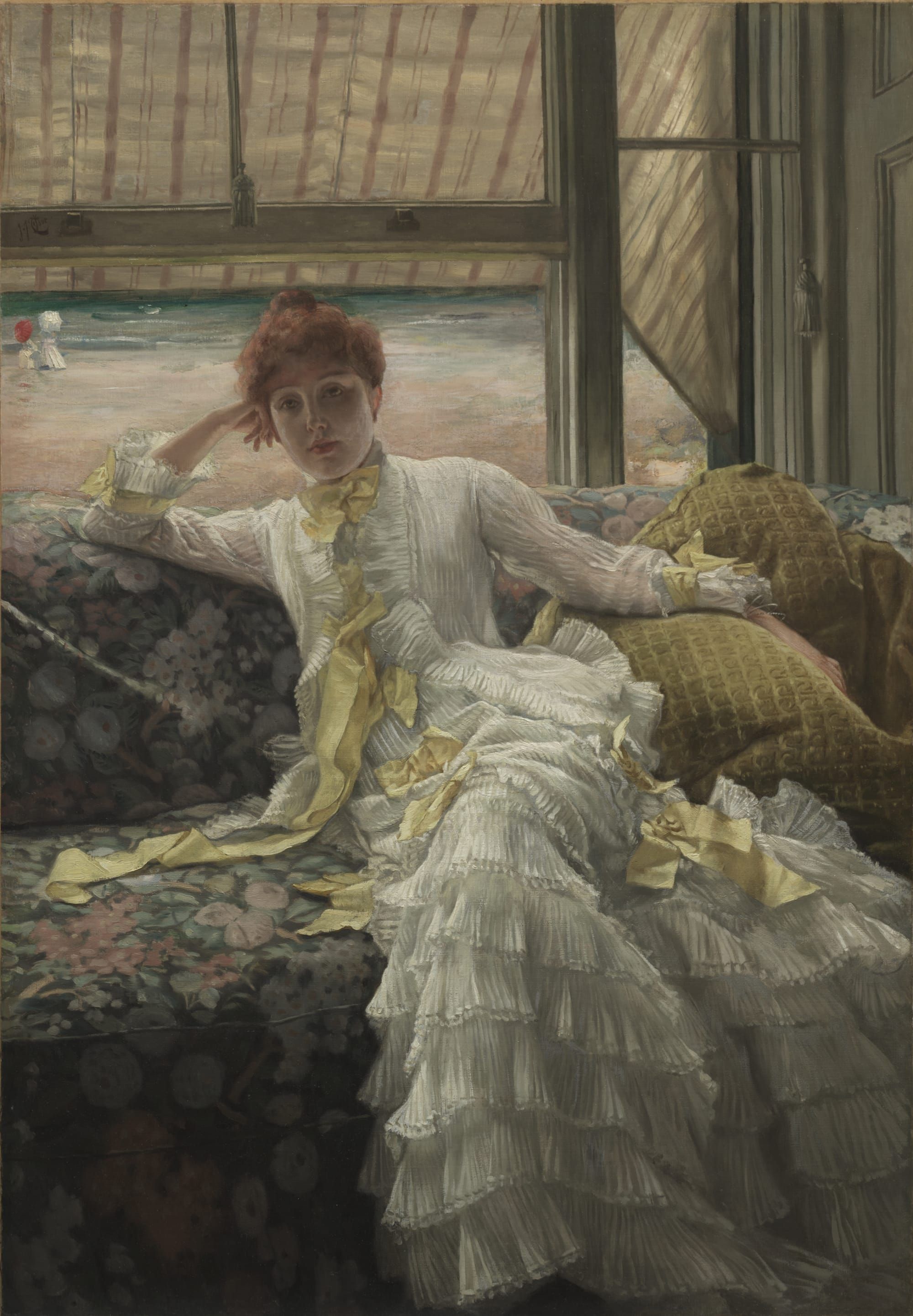

What we see in the painting, is a woman on a sofa. That is the first and most obvious thing. She is dressed in white, with yellow ribbons placed here and there like small eruptions of sunlight. The dress takes up much of the painting, spreading across the furniture in folds, frills, and textures. The dress seems to be an event in itself.
The woman leans back with her head resting on her hand. Her other arm stretches out along the sofa, almost lazily. She looks toward us, but not with surprise. She does not seem caught. She does not look as if we have interrupted anything important. On the contrary, she looks as if interruption is exactly what she has been waiting for.
Behind her, through the window, there is the sea. We see a beach, with water beyond it, and a few figures moving around outside. We see small people by the shore, dressed in light colours. One has a red umbrella that catches the eye. They are far away, quite small, and yet they change the whole atmosphere of the painting. Without them, this would be an interior scene: a woman indoors, surrounded by fabric, cushions, and curtains. But because they are there, just outside, the painting becomes to me about the strange division between inside and outside, participation and distance, life lived and life observed.
The woman is at the seaside, but she is not quite at the sea, like the others.
This is, I think, what makes the painting interesting. She has come to the place where one is supposed to be refreshed. The seaside promises air, health, movement, salt, light, loosened routines. It offers something outside the stiffness of the city and the demands of society. But here she is, indoors, lying on a sofa, with the blinds partly drawn. The beach is visible, but it is also kept at a distance. The world is available to her, but only as a scene.
And perhaps that is not so unusual. We often go somewhere in order to feel different, only to discover that we have brought ourselves along. The body has travelled, the surroundings have changed, but the inward weather remains much the same. There is sea outside the window, and still one can feel enclosed. There are people walking on the beach, and still one can feel alone. There is leisure, and still one can be restless.
The sofa is patterned, the cushions are heavy, the dress is magnificent, the window frame is carefully placed, and the blinds soften the light. Everything is refined. Yet the mood is not simply pleasant. Something in the woman’s expression resists that. She seems neither happy nor unhappy. She is somewhere in between, which is often where real life takes place, perhaps. The woman in the painting seems to have time. She has comfort, and she has beauty around her. And yet time, comfort, and beauty do not automatically produce meaning.
When I look at the painting, I keep returning to the woman's gaze. It is not dramatic, but it is somehow difficult to escape. She looks at us as if she has already understood the rules of the scene and is weighed down by it. She knows she is being seen. She knows how she appears: graceful, fashionable, composed, perhaps a little bored. But there is also a kind of intelligence in the look, a question almost. “Well?” she might be saying. “Is this what you came to see?”
The philosopher Blaise Pascal once wrote about diversion, by which he meant the way people keep themselves busy in order not to face themselves too directly. Hunting, conversation, games, social duties, travel—these things may be pleasant, but they can also protect us from the silence in which we discover our own restlessness.
Looking at Tissot’s painting, I wonder whether seaside leisure functions this way. The beach outside is a form of diversion. So is the dress. So is the social world implied by the whole setting. There are people outside; there may be visitors later; there may be walks, lunches, glances, bathing, letters, and polite conversations. But for this moment, none of that is happening. The woman is alone with time. And time, when it is not filled, can become quite loud.
One of my philosophical heroes, the Danish Søren Kierkegaard, also comes to mind, especially his reflections on boredom. For him, boredom was not just a small inconvenience but something deeper: a sign of the self’s difficulty in becoming itself. That may sound too grand for this painting, and perhaps it is. Still, the idea helps us see something, I think. The woman is not suffering in any obvious way. She is not trapped by poverty, danger, or violence. She is surrounded by softness. But softness is not the same as freedom. Comfort can become another kind of enclosure.
Still, the woman is not merely spoilt, and the outside world is not merely healthy and pure. The beach figures are distant enough that we cannot know anything about them. Perhaps they too are bored. Perhaps they too are performing their roles. The seaside is not automatically authentic just because it is outside. People can be just as artificial in the open air as in a drawing room.
The contrast remains powerful, somehow. The woman sits in a beautifully arranged world, but the painting allows us to feel the cost of arrangement. Everything has its place. The ribbons, the folds, the cushions, the blinds, the body. Even relaxation appears composed. She is resting, but it is a very elegant form of rest. One wonders whether she is allowed to collapse in any ordinary human way.
That is perhaps why the small people on the beach matter so much. They are not the subject of the painting, but they give the painting its horizon. They remind us that there is a larger world beyond the room. A world where bodies move without being arranged for our viewing. A world of weather, wet sand, voices, wind, and awkward movement. Their smallness is important. They are almost nothing, and yet they open the painting.
Because much of life happens like this: with the real thing visible but not quite reached. The sea is there. The light is there. Other people are there. Possibility is there. But between us and it, there are curtains, habits, expectations, tiredness, social roles, and perhaps simply the difficulty of getting up.
Maybe the woman will rise in a moment. Maybe she will adjust her ribbons, step out of the room, and walk down to the beach. Maybe she will join the figures outside and become, from someone else’s window, one of those small white shapes by the water. Or maybe she will remain where she is, letting the afternoon pass through the blinds.
Tissot does not tell us. That is what makes the painting stay alive. It gives us a scene that is finished in paint but unfinished in thought.
And in the end, Seaside may not be about the sea as much as the nearness of the sea. It is about being close to life, close to freshness, close to the world outside oneself, but not yet fully entering it. The painting captures that strange pause. The moment before movement. The moment in which one could go outside, but has not gone yet.
Fascinating.