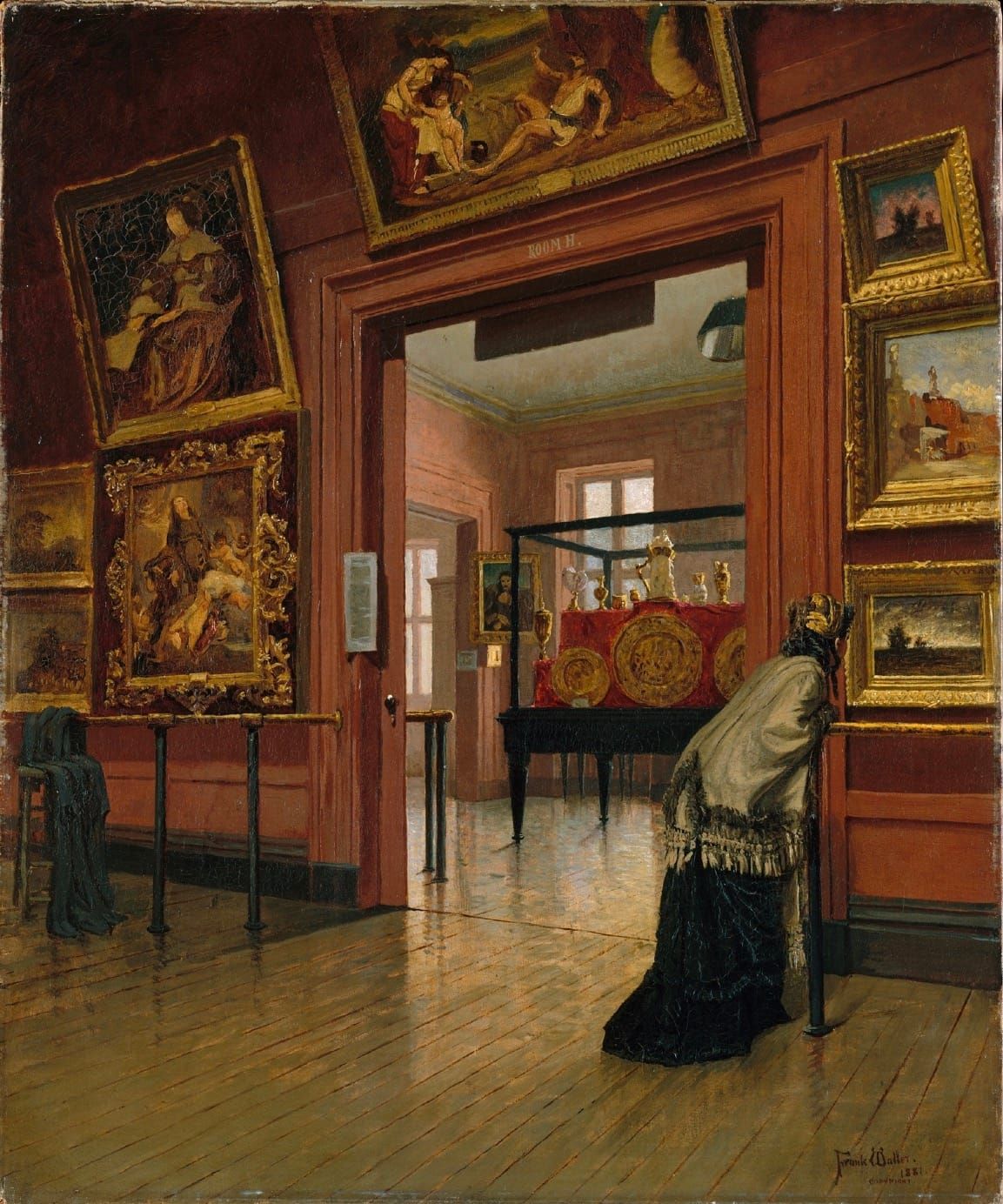

At first, the room seems almost crowded with paintings: gilded frames, red walls, a polished floor, a doorway into another gallery, display cases, smaller pictures hung high and low. From the title we learn that the painting represents the Metropolitan Museum of Art, but the Met appears here not as the grand, monumental institution we may think of today. It is much more intimate, in a way, displaying its art in a very different manner compared to the present-day museum. The warm colours, the wooden floor, the slightly irregular hanging of the works, and the visible doorway all make the museum feel like a series of furnished rooms rather than a neutral exhibition space.
I didn't think about it when I first encountered the painting, but the woman on the right is crucial. She leans forward to examine a painting closely, and—and in a way—that small gesture gives the whole picture its life. Without this woman, the museum would be "dead", so to speak; the art hanging on the walls would not have anyone to be important to. The visitors' interest in the displayed art actualises the potential of the art, the potential of bringing someone something new.
And further, the painting does not present museum-going as a passive activity. Looking is an activity: one bends, pauses, compares, reflect. The woman’s body creates a quiet tension with the surrounding paintings. She is not overwhelmed by the collection but rather absorbed by one part of it.
There are several artworks that can be identified in the painting. The Wages of War (1848) by Henry Peters Gray is installed prominently above the doorway in the middle ground. Saint Rosalie Interceding for the Plague-Stricken of Palermo (1624) by Anthony van Dyck is visible to the left of the doorway in the main gallery. Portrait of a Young Woman by Cornelis de Vos is hanging on the wall directly above the Van Dyck, and an unknown portrait (formerly attributed to Leonardo da Vinci) is visible in the far room in the background, a loan from a private collector at the time. All of these are in the Met's collection, even today.
With all the partworks present, there is something charmingly self-referential about the painting, something almost Magritte-ish, I think. We are looking at a painting of someone looking at a painting inside a museum full of paintings, and in this way, the layers of interpretation start piling up. Which artwork matters most here? The large dramatic canvas on the left? The small picture the woman studies? The treasures in the next room? Or the painter’s own painted view of the entire scene? The answer is perhaps all of them, but only through the act of someone stopping to look. Again, human interest and the way art renders reality differently in different kinds of perspectives are what make art interesting in the first place.
The painting says, perhaps, something about museums in the late nineteenth century. The display feels dense and decorative compared with modern galleries, where paintings are often given wide spaces and white walls. Here, the museum is closer to sort of a "cabinet of culture": paintings, frames, objects, rooms and viewers all forming one visual environment. The viewer is invited not just to admire individual masterpieces but to experience the atmosphere of collecting, education and cultivated leisure.
What I find most appealing is the painting's modesty. The painter does not dramatise the museum as a temple of genius. He shows a quiet moment: a visitor, a room, a painting, a pause. In that sense, the work honours the ordinary seriousness of looking, so to speak. It suggests that art lives not only in grand historical narratives but also in these small encounters—when a person stops, leans closer, and allows a picture to hold her attention. I really like that art can have this diversity.
Short About The Artist
Frank Waller was an American artist, born in New York in 1842 and later active as a painter, architect, teacher and advocate for art education. He died in Morristown, New Jersey, in 1923. The Metropolitan Museum—where the painting above appropriately is displayed—lists him simply as "American", but his career seems especially tied to the cultural life of New York in the late nineteenth century.
What is interesting, in relation to the painting above, is that Waller was not only interested in making pictures. He was also concerned with the role of museums and art instruction in forming public taste. The Met’s own note says that he “endeavored to improve American taste and art instruction” and welcomed the rise of new museums like the Metropolitan, which had opened in 1870.
That makes Interior View of the Metropolitan Museum of Art when in Fourteenth Street feel almost like a statement of belief. Waller paints the museum as a place of education and moral attention, not just display. In that sense, the painting reflects Waller’s broader commitment to art as something that should cultivate the public. A view, I think, that is relevant even today.