
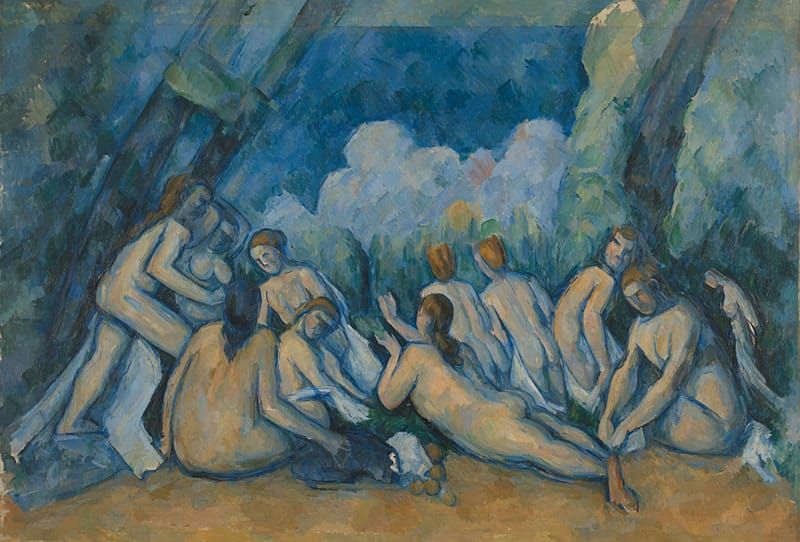

There is no obvious water. However, there are bodies—female, it seems—and clothes and trees and sky. But the act of bathing is not really shown. The women are not clearly entering a stream or washing themselves or playing at the edge of a pool. They are gathered in a wooded place, seated quite close together, enclosed by great diagonal trunks and a dense, kind of restless atmosphere. At first sight the title seems to be an apt one, but when investigated there is not much resemblance to traditional bathing.
What they bathe in, perhaps, is not water but colour?
The first thing that strikes me is the blue. It is not only in the sky, although the sky is intensely blue. The blue is in the trees, in the shadows, in the outlines of the women, in their flesh, in the air around them. Especially the women closest to the sky are affected. Blue does not behave here as background. It enters the whole painting, more or less like a substance. The clouds, too, do not simply float behind the scene; they sit there like another body, close to the ground behind the women.
And against this blue is the yellow, or rather the ochre-yellow, the sandy warmth of the ground and of human skin. The figures are not painted with the soft, pink idealisation we may expect from a classical nude (if that was ever the inspiration for Cézanne's painting). They are made from earthy colours. Their bodies are yellow-brown, orange, clay-like. Especially the women closest to the ground seem to be affected by their surroundings; it is as if they have been formed out of the same ground on which they sit.
So the painting becomes a meeting between blue and yellow: sky and earth, distance and nearness, coolness and warmth, atmosphere and flesh. But Cézanne does not let these colours remain separate. The blue invades the yellow bodies; the yellow warms the landscape. The bathers are human, but not entirely detached from the world around them. They are not placed in nature as visitors. They are made of it, and are affected by it.
This, I think, is why the indistinctness of the figures matters in this painting. The bathers are blurry, but not in the way a careless painting is blurry. This seems to be an intended blurryness. The representations are not quite portraits. The women's faces are difficult to read, sometimes mask-like, sometimes turned away, sometimes hardly there at all. Even their bodies, though strongly outlined, seem to have a double meaning. They lean, fold, bend, and merge into one another. A shoulder becomes a branch-like angle. A back becomes a slope. A thigh takes on the same weight as a tree trunk. The National Gallery notes how Cézanne’s repeated blue outlines help integrate the women with their surroundings, making them appear not physically separate from the landscape but part of it.
And this raises an interesting issue with how we relate to the world around us. Instinctively, I think, we want to distinguish the figures. We want to identify them, to make them into individual women with faces, intentions, and relationships. Make them people that we recognise. But Cézanne frustrates this desire. The women do not step forward into psychological clarity. They remain half absorbed in the painting’s larger structure. They are present, but not... what shall we say... available.
The title Les Grandes Baigneuses therefore becomes slightly misleading and deeply appropriate at the same time. They are not “great” because they are grand individuals. They are great because the painting’s question is great. How does nature hold the human form? Where does the body end and the world begin?
The bathers in the painting are not represented in a clear-cut way, but then again, neither are we. We like to imagine ourselves as distinct persons, neatly outlined, separate from the background of our lives. But perhaps we too are more like these figures than we admit: made from the colours around us, partly shaped by the atmosphere we inhabit, never entirely separate from the world that holds us.
Paul Cézanne, in Short Terms
Paul Cézanne was born in Aix-en-Provence in southern France in 1839. His father was a successful banker, and for a while Cézanne followed a path that was expected of him rather than one he had chosen himself. He studied law, but his real desire was painting, and eventually he left for Paris, where he tried to enter the artistic world more fully.
Paris, however, was not an immediate success for him. Cézanne was socially awkward, intense, and often uncertain of himself, and his early paintings were dark, heavy, and emotionally charged. He was close friends with the writer Émile Zola from childhood, although their friendship later broke apart, partly because Cézanne felt wounded by Zola’s fictional portrayal of a failed artist in the novel L’Œuvre.
Cézanne became connected with the Impressionists and exhibited with them in the 1870s, but he was never quite one of them in temperament or ambition. Where Claude Monet (1840-1926) and August-Pierre Renoir (1841-1919) often sought the fleeting impression of light and atmosphere, Cézanne wanted something more solid. He wanted, as it is often said, to “make of Impressionism something solid and durable". His paintings therefore seem to hold two desires at once: the freshness of sensation and the firmness of structure.
Much of his mature life was spent away from Paris, in and around Aix-en-Provence. There he painted still lifes, portraits, landscapes, bathers, and above all Mont Sainte-Victoire, the mountain that became almost a lifelong companion in his work. He returned to the same motifs again and again, not because he lacked imagination, but because he was investigating how things come into visibility: how apples sit on a table, how a mountain rises in space, how a body belongs to a landscape.
Cézanne died in 1906, still not entirely understood by the wider public. But shortly after his death, his importance became undeniable. Later artists, especially the Cubists, saw in him a new way of building a picture—not through smooth illusion, but through planes, colour, pressure, and structure. Pablo Picasso (1881-1973) and Henri Matisse (1869-1954) are both said to have regarded him as a kind of father of modern painting.
In this sense, Cézanne stands at a fascinating threshold. He comes after Impressionism but before the radical modern movements of the twentieth century. He still paints apples, mountains, bathers, and trees, but he paints them as if the world had to be constructed again from the beginning.