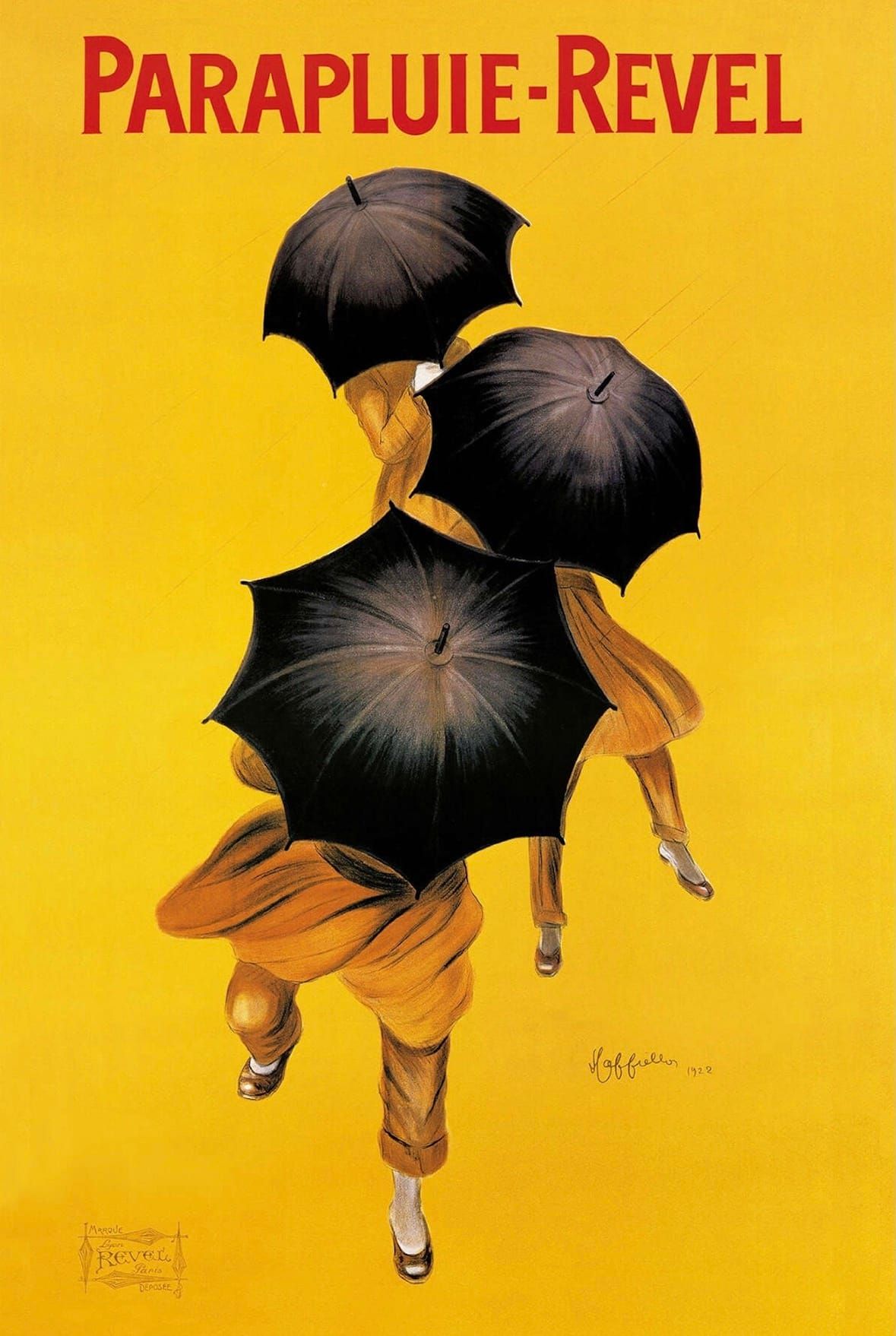

I don't know if the image in this post counts as art, but at least it has an artistic feel to it. It is a vintage advertising poster for Parapluie-Revel, a French umbrella brand, and shows three figures seen from above, each carrying a black umbrella. Against the intense yellow background—and against the ochre-ish colour of the three figures' dresses—the umbrellas become the central visual rhythm: dark, circular, almost flower-like forms moving diagonally across the picture.
What is striking is that the people are partly hidden. We do not really see faces, expressions, or personalities. Instead, we see movement, clothing, posture, and the umbrellas themselves. The advertisement does not simply say, “Here is a useful object for rain.” It turns the umbrella into an object of style, mystery, and some kind of urban elegance. From above, the umbrellas become their faces, so to speak. The umbrellas both conceal and define the figures. They are anonymous, but elegant; hidden, but visible; protected, but also displayed. The product becomes a symbol of modern identity: something practical that also shapes how one appears in public.
What I think is particularly striking with such a depiction of the umbrellas is that it suggests that style can begin with ordinary objects. And I think this holds true for almost anything. An umbrella, as in this poster, is not merely something one carries in the rain. It is a sign of grace, rhythm, and social presence—a small roof under which the modern self moves through the world. To put it a bit poetically. I really like the idea that a thing isn't just a thing.
The Artist
Leonetto Cappiello was one of the great figures of modern poster art. He was born in Livorno, Italy, in 1875 but made his career mainly in Paris, where he moved in the late 1890s. He died in Cannes in 1942.
He began not as an advertising artist, but as a caricaturist. In Paris he drew actors, writers, fashionable personalities and performers for satirical and illustrated magazines. Here he was trained to reduce a person or scene to one memorable gesture, silhouette or attitude—exactly the skill that later made his posters so powerful.
Cappiello is often called the “father of modern advertising” or the father of the modern poster. The phrase is a little grand, but it points to something real. Earlier Belle Époque posters, such as those by Jules Chéret, often had a decorative, painterly, almost theatrical abundance. Cappiello simplified. He created posters that could be grasped instantly from the street: one striking figure, one strong colour contrast, one unforgettable visual idea.
His genius was not merely to illustrate a product but to invent an image for it. A chocolate, a bitter, an umbrella, a tyre or a perfume became attached to a single visual sign: a leaping figure, a devil, a mysterious silhouette, a burst of colour. In this sense, he helped move advertising away from description and toward branding.
This perspective is also prominent in the poster above. Here, he does not show the technical quality of the umbrella. He does not explain its fabric, handle or durability. Instead, he gives the brand an atmosphere: elegance, urban movement, anonymity, fashionable protection. The umbrellas become almost abstract black circles against the yellow ground. What you remember is not an object, but a visual rhythm. It makes you feel something, rather than learn something. The poster did not need to tell a story in detail. It needed to leave an image in the mind.
Cappiello belongs to the transition from Art Nouveau into the cleaner, more graphic language associated with Art Deco. His work still has the wit and elegance of the Belle Époque, but it looks forward to twentieth-century advertising: reduced forms, bold colours, dramatic contrast, and immediate recognition.