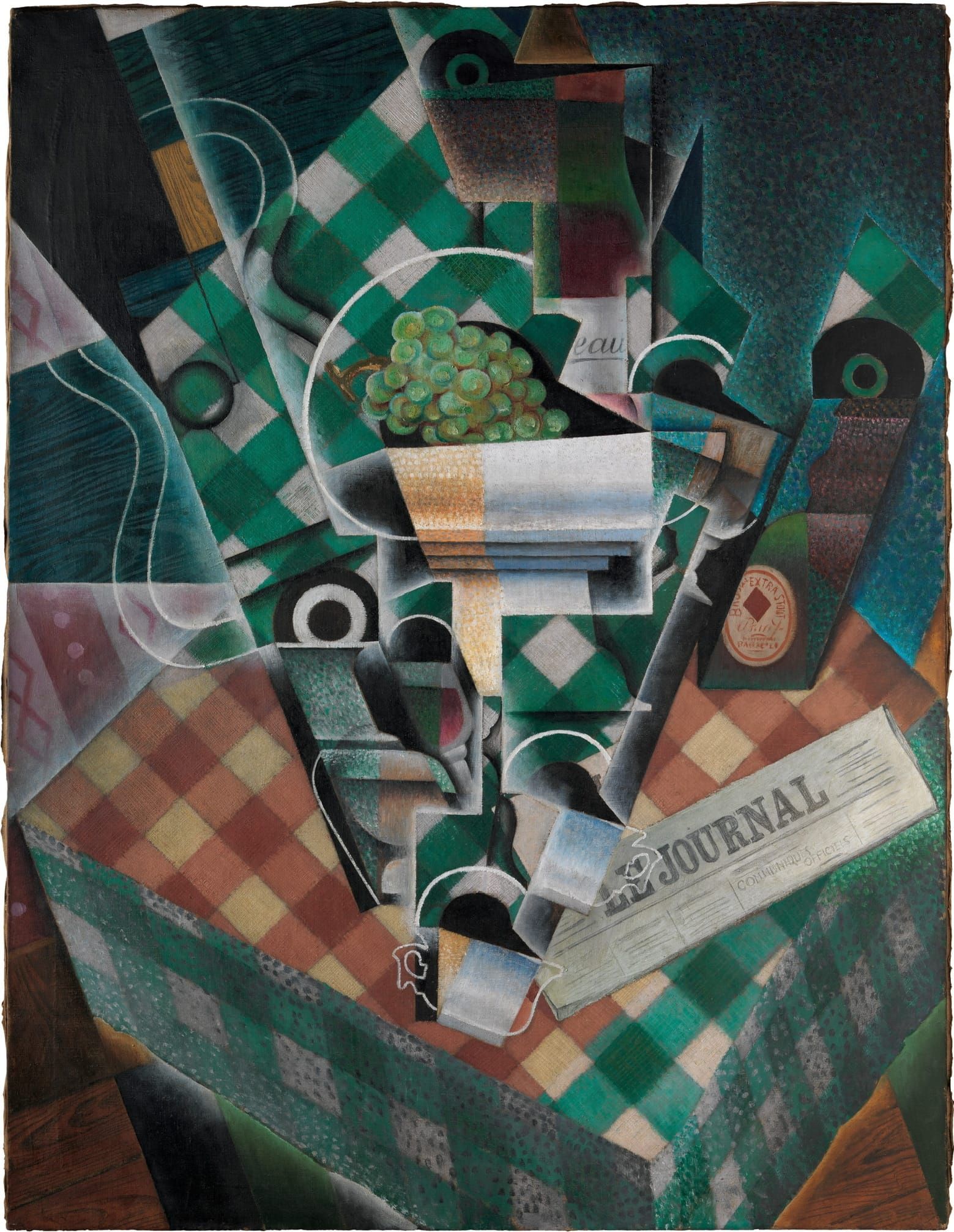

Juan Gris’s (1887-1927) Still Life with Checked Tablecloth has the kind of order that at first looks almost chaotic. The table is crowded with fragments: grapes, a newspaper, a bottle or glass, a checked cloth, perhaps a guitar-like curve, bits of wood, labels, rims, shadows, and repeated circular forms. But still, there is a kind of order, and the longer one looks, the more it feels like a carefully constructed system.
What is striking is that Gris does not simply paint objects on a table. He seems to rebuild the table itself, the objects, and the surrounding space from the same visual material. The checked tablecloth is especially important. In a traditional still life, a tablecloth might be a background or decorative support. Here it serves as one of the main elements. Its grid holds the picture together, but it also tilts, folds, and breaks apart so that the surface of the table and the surface of the painting begin to merge.
The objects are recognisable, but only partly. The grapes are probably the most immediately readable element: round, soft, natural, almost edible. Around them, the other things are more fractured and abstract. This contrast lends the painting some warmth. The grapes keep it from becoming purely intellectual; perhaps they remind us that Cubism was still connected to everyday life—but wine, newspapers, cafés, tables, conversation.
The newspaper is also significant. It brings modern life into the still life. A newspaper is temporary, public, made of language and current events. Grapes and bottles suggest taste and pleasure; the newspaper suggests the outside world. Gris places them together as if modern experience itself has become a still life: objects, information, leisure, commerce, and perception all folded into one another. It is less like looking through a window and more… assembling a thought, in a way.
The painting has fragmentation, but not violence. The pieces seem arranged with care, as if they depict a world that someone has taken apart but not destroyed. In fact, the objects have been rearranged into something quite different; it seems to be the head of a bull in the painting.
To me, the painting is a reminder of the fact that seeing is never simple. We do not take in a table, a glass, a newspaper, and fruit all at once in a single neutral glance. We notice edges, textures, words, and then memories, habits. Gris turns that process into form. The painting is not only a still life of things on a table; it is a still life of how we perceive—how the world arrives in fragments, and how the mind quietly puts it together.
The Artist
Juan Gris was born José Victoriano González-Pérez in Madrid in 1887. He later adopted the name Juan Gris and became one of the central figures of Cubism—though he is often a bit overshadowed by Pablo Picasso and George Braque.
He trained first in Madrid, where he studied engineering and drawing. This may partly explain the clarity and structure of his later paintings: Gris often seems more "architectural" and carefully composed than many of his cubist contemporaries. In 1906, when he was still young, he moved to Paris, which was then the preeminent center of modern art. There he lived in the renowned artists’ building Bateau-Lavoir in Montmartre, where Picasso also lived for a time.
At first Gris worked mainly as an illustrator and cartoonist, contributing drawings to newspapers and magazines. Around 1910–1912, however, he began to paint seriously in a cubist manner. He was deeply influenced by Picasso and Braque, but he soon made his version of Cubism recognisably his own. Where early Cubism could be brown, austere and analytical, Gris often brought in brighter colour, stronger design, and a more decorative sense of order.
He was especially important in what is often called 'synthetic Cubism'. This was the phase of Cubism that used clearer shapes, collage-like effects, patterned surfaces, letters, labels, newspapers, musical instruments, bottles, glasses and café objects. In Gris’s work, these fragments often feel less like a puzzle and more like a carefully balanced construction. He imparts ordinary things—a newspaper, a tablecloth, a fruit bowl—with a kind of intellectual elegance.
His life was not long. Gris struggled with poor health, especially in his later years, and died in 1927, only 40 years old. But within that short life he developed one of the most refined and coherent forms of Cubism. In response to a questionnaire circulated by Amédée Ozenfant and Le Corbusier, editors of L’Esprit Nouveau, no. 5, in February 1921, Gris stated:
Cézanne made a cylinder out of a bottle. I start from the cylinder to create a special kind of individual object. I make a bottle—a particular bottle—out of a cylinder.
Much like in the painting on the top of this post.