

Art history is—to a layman like myself—immensely captivating. I'm not sure why the field of art history speaks to me so intensely—whether it resonates with my general interest in history, reflects the evolution of imagery that represents who we are and how we live, comments on our identity, or embodies the rule-breaking that reckless artists aspire to. Regarding this painting, it is definitely the latter.
Eduard Manet (1832-1883) is presented, at least to some extent, in an earlier post here at Naive Notions, so I will jump right into some reflections about the painting.
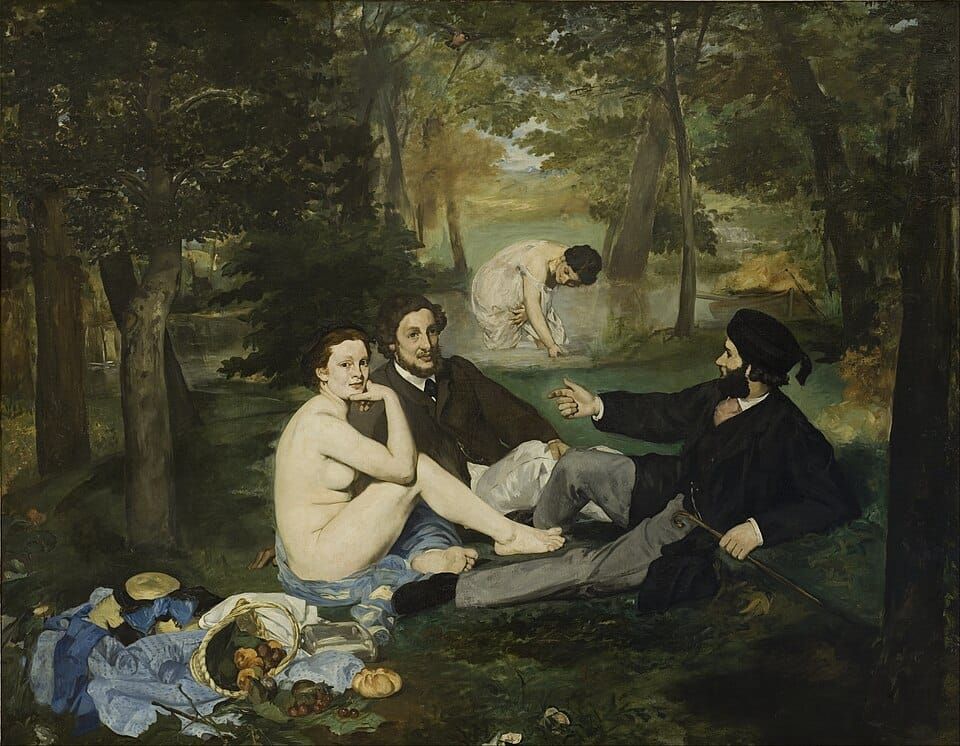
The scene in the painting appears simple: two men sit outdoors with a naked woman. The men wear contemporary dark suits. It seems awkward that she is naked while the men are clothed, but as we shall see, there is more to it than just awkwardness. Another lightly dressed woman bathes in the background. A basket of fruit and clothing lies in the foreground, indicating that they have had a picnic. The nude woman sits in the same space as the men, but she seems psychologically separate. She does not interact much with the men; instead, she turns outward toward us.
The Historical Context
To understand how this painting impacted contemporary society, we have to look at the art tradition of the time. When Manet painted Luncheon on the Grass, French art was still dominated by the official Paris Salon, where works were judged according to academic ideals: polished technique, historical or mythological subjects, moral seriousness, and idealised beauty. The academic art tradition was not just a style but an entire institution: a way of training artists, judging paintings, ranking subjects, and deciding what counted as “serious” art.
At the top of this tradition stood history painting. This meant paintings based on classical mythology, the Bible, ancient history, heroic events, or morally elevated themes. Such paintings were considered superior because they were thought to address universal human values: courage, sacrifice, virtue, beauty, tragedy, divine order.
Below history painting came portraiture, genre scenes, landscape, and still life. This hierarchy was important because artists who wanted recognition usually had to show that they could handle grand themes, idealised bodies, complex compositions, and morally respectable subjects.
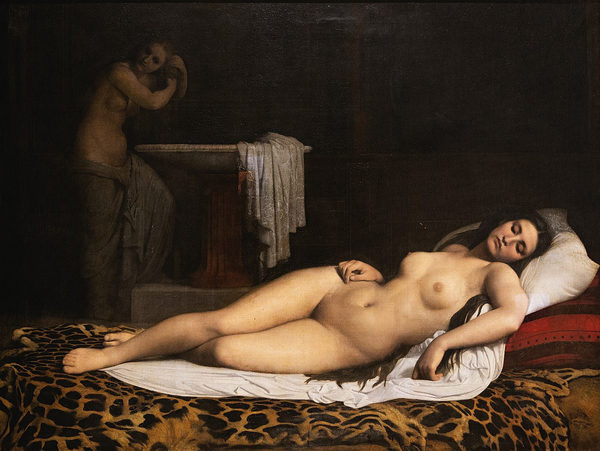
The academic nude was central to this system. Students learned by drawing from antique sculptures and from live models. The ideal body was not supposed to be merely a real body copied from life but a perfected form, shaped by classical standards of proportion, grace, and harmony. A nude woman would be acceptable—even celebrated—if she appeared as Venus (the goddess of love and beauty), Diana (the goddess of the hunt and the moon), Athene (the goddess of wisdom and war), a nymph, an allegory, or some other figure safely removed from ordinary modern life.
The breaking of tradition
This is why Manet’s painting caused such discomfort. The scandal was not simply that the painting showed a nude woman. As mentioned, nudes were common in academic art. The problem was that this woman was not presented as a goddess such as Venus or Diana or an allegorical figure. She appeared to be a contemporary Parisian woman, sitting naked in a park beside two fully dressed modern men. Even more unsettling, she looks directly at the viewer, calmly and confidently, as if refusing to be embarrassed.
And further, academic painting also valued a highly finished surface. Brushwork was expected to be controlled, polished, and almost invisible. A good painting should create the illusion of a coherent world, with convincing depth, careful modelling of bodies, balanced composition, and smooth transitions of light and shadow. Manet’s flatter lighting, sharper contrasts, and less seamless spatial construction seemed crude to many viewers because it broke with these expectations.
So the scandal was double, so to speak. Manet challenged academic tradition both in subject matter and in technique. He used references to classical and Renaissance art, but he stripped away the noble disguise. He kept the compositional seriousness of the old masters while replacing their mythological world with the… what can we call it… uncertainty of modern life.
In 1863, Manet had the courage to submit the painting to the official Salon, but it was rejected. However, that year, so many artists protested the Salon’s rejections that Napoleon III allowed a separate exhibition: the Salon des Refusés, or the "Exhibition of the Rejected". Even here, Manet’s painting became one of the most scandalous works.
The Nude Placed in Our Midts
One of the most striking elements in the painting is the woman’s gaze. She does not seem passive; she knows she is being looked at. Her expression does not invite fantasy from distant times; instead, she confronts the viewer’s act of looking. The woman challenges the viewer. «Let's have this game,» she seems to be saying. «Let us stare at each other, me naked and you with clothes on, and see who turns away first.» The viewer becomes implicated in the scene, in a way, an accomplice to the obscenity of the scene.
In this sense, Luncheon on the Grass is not merely a scandalous painting of a nude woman among clothed men. It is a painting about the collapse of old artistic excuses. Manet removes the veil of mythology and leaves the viewer facing modernity itself: awkward, ambiguous, sensual, and unresolved.
Legacy
Luncheon on the Grass is often seen as a turning point in modern painting. It did not begin Impressionism exactly, but it helped make it possible, and many of the aspiring Impressionists drew inspiration from him. Manet showed that painting could take contemporary life as its subject without dressing it up as history or myth. He also showed that the surface of a painting did not have to disappear behind perfect illusion.
Fascinating.