
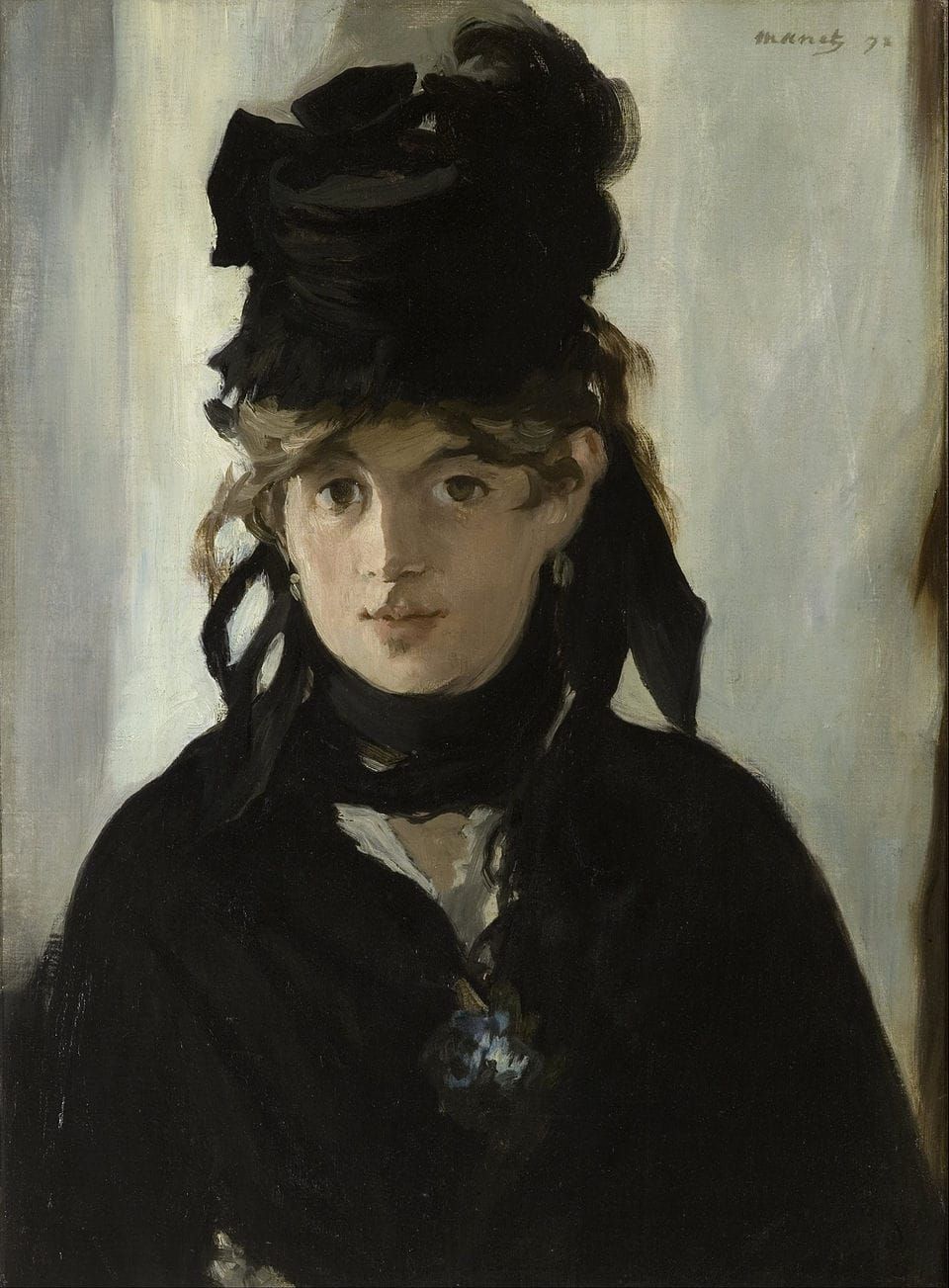

The painting above was made by Édouard Manet in 1882, two years before the model, Berthe Morisot, married Édouard’s brother. Édouard himself was married at the time, but as I understand it, it is possible to suspect that Manet and Morisot engaged in a romantic relationship. However, no indiscretions have been confirmed, but that, of course, does not keep the rumours from circling.
Édouard Manet (1832-1883) was a French painter who is widely regarded as one of the most important artists of the 19th century and a major influence on modern art. His innovative use of colour, composition, and subject paved the way for the development of new artistic movements.
Manet was born in Paris on January 23, 1832, into a wealthy family. His father was a senior official in the French Ministry of Justice, and his mother was the daughter of a diplomat. From a young age, Manet showed an interest in art and began studying under various artists in his early twenties, including Thomas Couture.
In 1859, Manet exhibited his painting "The Absinthe Drinker" at the Salon, an official exhibition of the French Academy of Fine Arts, but it was met with criticism and ridicule. His work was controversial and often rejected by the art establishment of the time. This rejection by the art establishment would continue throughout his career, and Manet could never really accept that he remained an outsider of the establishment. His work, however, was a key inspiration to a younger generation of artists, the likes of Auguste-Pierre Renoir and Claude Monet, who established the Impressionistic art movement.
Despite his poor health, Manet continued to paint until his death on April 30, 1883, at the age of 51. Although he faced criticism during his lifetime, Manet is now widely regarded as one of the most important artists of the 19th century and a major influence on modern art. His innovative use of colour, composition, and subject paved the way for the development of new artistic movements.
The painting
Berthe Morisot was an artist in her own right, and she met Manet at the Louvre in 1868 while the 27-year-old Morisot was spending the day copying a Rubens in the museum. She already knew Manet by reputation, and she admired him. He had created a sensation at the Salon and Salon des Refusés with his scandalous Olympia and Luncheon on the Grass and was the de facto leader of the Parisian avant-garde. His work had started to transform the art world from Academic Realism to what subsequently was to be termed Impressionism, and Morisot must have been a bit starstruck when she first met him.
Morisot became one of the three most famous female artists in the Impressionistic movement (the other two being Mary Cassatt and Marie Bracquemond), but before this Morisot was a six-time exhibitor at the official Paris Salon in the years 1864-73. However, when Monet and party arranged their own exhibition in 1874 (what was subsequently to be called the first Impressionistic exhibition), she participated along with Paul Cezanne, Edgar Degas, Claude Monet, Camille Pissarro, August-Pierre Renoir, and Alfred Sisley. Her contribution was the painting The Cradle, from 1872, showing Morisot’s sister with her child. It was, in fact, Morisot that encouraged Manet to venture out of this studio and start to paint en plain air, as Morisot herself had been inspired by the Barbizon group some time earlier. The move from the studio out into the open became a hallmark for the Impressionists, who wanted to capture life as it was experienced by the people and not some stylistic allegory that was the prime focus of the academic art tradition.
Note on the Barbizon group
The Barbizon group was a French group of painters whose name they took after the village in which they worked that—in many respects—kick-started Impressionism. The artists in the group provided an alternative to realism, which arose in the context of the dominant Romantic Movement of the time. They took advantage of the small tubes of paint that were entering the market by leaving the studios and moving outside to paint in the open air.
Many worked using looser brushstrokes and a freer style than was traditional in academic painting. These experiments had a profound impact on the work of the artists subsequently named Impressionists, who travelled to Barbizon as young artists to learn from the members of this school.
A Marriage of Convenience?
The year of the first Impressionistic exhibition was also the year Morisot married Manet’s brother Eugene. I find it interesting that when roaming the web for information about this marriage, speculation varies about the motivation for Morisot to marry Eugene. At the time of marriage, Morisot was 33 years old, relatively old compared to standards of the day. She had been eager to promote her art and postponed a marriage for as long as she could. Some argue that she, at this point, finally wished to settle into a more conventional life; others point to the fact that her mother had wished her to find a husband. Still others have reasons to believe that by marrying Eugene, she could stay closer to her soulmate, now her brother-in-law, Édouard.
In the painting, Manet had chosen black to a larger degree than usual at the time. The Impressionists—whom he greatly inspired with his work—were making pictures that were lighter in colour, but Manet was looking to his own inspiration of Velázquez and Goya and selecting darker colour tones. Some of his other motives are lighter in the choice of colours, but never when he painted Morisot. Even the eyes of Morisot are painted black, even though they are recorded as green elsewhere.
The painting was acquired by the art collector and critic Theodore Duret (1838-1927) before Morisot herself bought it in 1894. On her death in 1895, she left it to her daughter Julie, who kept it until her own death in 1966, after which it was acquired by the nation.
The portrait experienced
What, I think, is interesting is that the painting is so captivating in such an obvious way. When looking at the painting, I get the feeling that I’m the one who is being scrutinised and not the other way around. Berthe Morisot gazes at me with such intensity and obvious interest that I almost catch myself in being flattered. In the relationship that is established between the viewer and the painting, the model clearly is in change. “What do you think?" she is about to say. "What if I asked you out?”
I’m not a very experienced art connoisseur, but here I think I might understand what the rumour about a romantic relationship between the model and the artist was all about. How is it possible to paint someone in this way without having the feelings for her that the painting so evidently conveys? The way I envision Berthe Morisot, she is easy to fall for. If the look she is giving the viewer in the painting is anything to go by, she is one of those people that can charm anyone. There is a playfulness in her expression that makes me... well... interested. She displays an easiness and an ability, it seems, to live life on the light side that can be highly attractive.
The Liberation in Art
This characterisation of Morisot may not be true at all, of course, but this, I think, is what art does: it frees the picture from the model and demands the viewer to make up his or her own mind based on the depiction. The questing is not what was originally there. What was there in the first place might be a trivial fact from everyday life, but the artistic expression of this object, person or incident may make us see something else, something that gives us reason to hope. And—I must actually confess—this portrait gives me reason to hope, or rather an opportunity for choosing to believe, that there are people out there with these pure qualities. I have looked at this portrait a dozen times, and it keeps growing on me.