


Through the history of philosophy, the pendulum has turned many times, and in many directions. From the earliest of times, philosophers have inquired what it means to be, what it means to exist, and many of the pre-Socratic thinkers made this investigation into the human existence their primary focus. But already from Socrates onwards, the ideas became influenced by a sense of rationality, effectively applying a filter or a frame on the understanding of what is means to be a concrete and pure being.
Søren Kierkegaard (1813-1855) endeavoured to lay a different foundation for these fundamental questions. What is important to know about Kierkegaard when reading his texts is that he promoted the view that truth should not be theorised or talked about, but lived. Kierkegaard was not interested in an objective fact or truth (as such) as a basis for his life. He went in the opposite direction and ventured to find—or construct—a deeply personal foundation for his existence. Every person, he argued, had to make his or her own grasp of what it means to live. This is at the heart of Kierkegaard's philosophy.
Because of this—I think—Kierkegaard is one of those philosophers that has managed to stay relevant, not just as a curiosity, but as an inspiration for living. There is something in his way of saying things, his views, and his arguments, that makes meaning on a truly subjective and personal level. And that—I’m sure—never goes off style.
In this light, though, the heading of this post makes for a hopeless task because I, in fact, cannot tell you what Kierkegaard taught me. The effect of his views on my life is so tightly connected to my own experiences, that it would not make any sense to talk about it to anyone else. The results of what Kierkegaard has taught me, then, are hidden from the world, but I can tell you something about the parts of his writings that I have gained from contemplating.
Not everything in this post is derived directly from Kierkegaard himself; what I attempt is an application of his philosophy in a lived life in the 21st century.
Freedom & The Concept of Angst
Kierkegaard was one of the first to use the term angst to describe a psychological state, and to write systematically on the matter. And this, of course, long before psychologists had emerged as a separate profession.
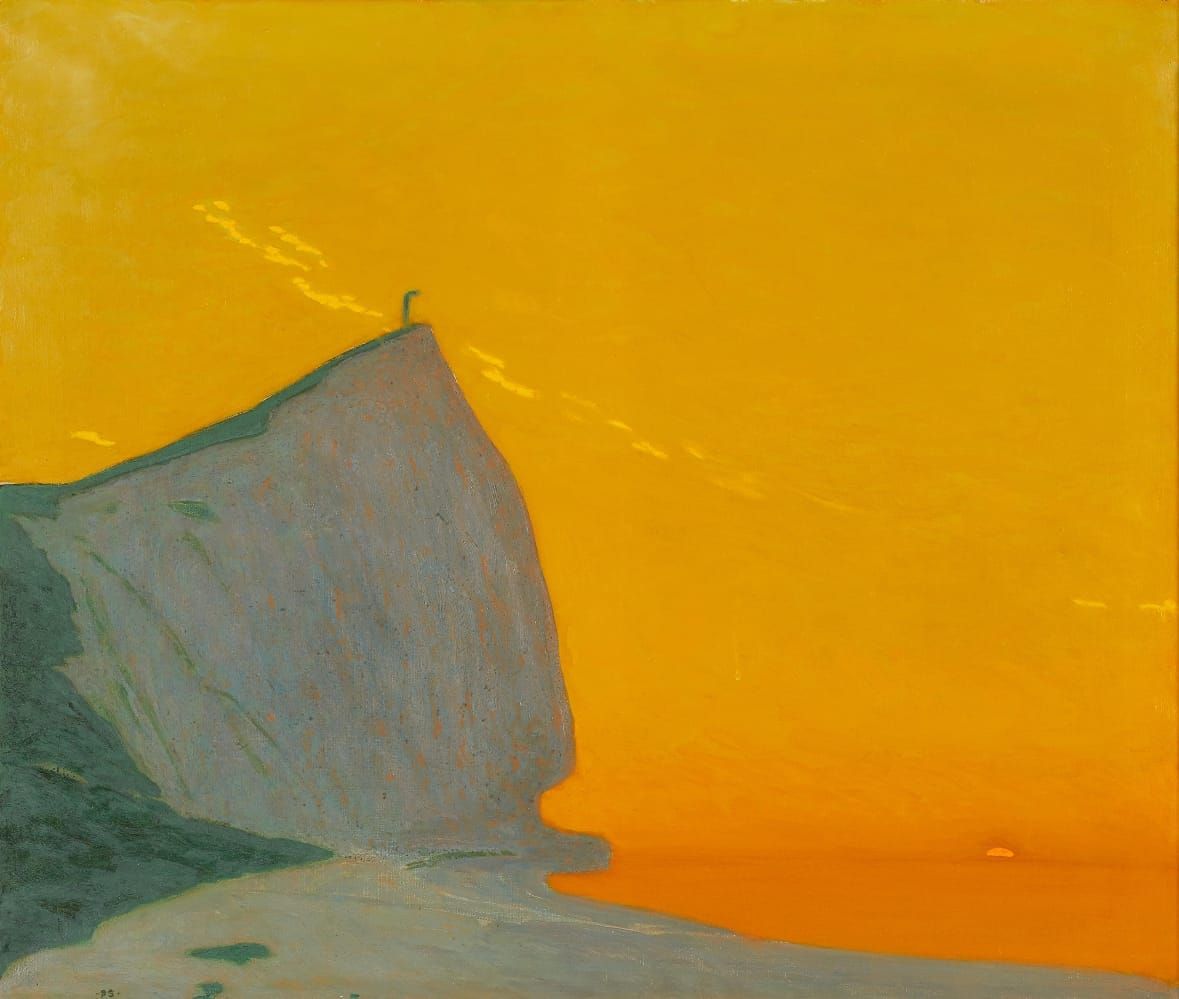
In his book from 1843, Fear and Trembling, Kierkegaard developed his concept of angst. He described this as some kind of “indeterminate fear”, a fear that lacks its object. A subject with angst is not afraid of something in particular, but experiences a general anxiety. To illustrate, Kierkegaard described what can happen when we stand on the edge of a cliff. We feel a fear of falling, a fear of the unknown, of losing control, perhaps. But alongside this fear—and this, I think, is an important point from Kierkegaard—we might also experience an urge to jump. There is something dragging us over the edge, something that quietly suggests that we have the possibility of jumping. Far back in our heads, there might be a voice whispering… “What if…” This is a consequence of our free will, we have the freedom to embrace what we know is dangerous, even if it destroys us, it is all up to us. It is our unlimited freedom, and the burden of managing this freedom, alone—with every possible lines of action open to us all the time—it is our own responsibility of choosing the right alternative.1
Note on Fear And Trembling
Kierkegaard published Fear and Trembling in 1843 under the pseudonym Johannes de Silentio (Latin for John of the Silence). The title refers to a line from Philippians 2:12, which says to, "continue to work out your salvation with fear and trembling". The Philippians verse is connected further to Psalm 55, which says in verse 4 and 5, "My heart is in anguish within me; the terrors of death have fallen on me. Fear and trembling have beset me; horror has overwhelmed me.".
The book, as such, explores the paradox of faith, the nature of Christianity and the complexity of human emotion. Kierkegaard examines the biblical story of Abraham, who was instructed to sacrifice his son Isaac, and Kierkegaard forces us to consider Abraham’s state of mind. He investigates what drove Abraham, and what could have made him carry out such an absurd and extreme request from God.
Kierkegaard argues that Abraham’s agreement to sacrifice Isaac, and his suspension of reason, elevated him to the highest level of faith. Kierkegaard explores more comprehensible alternatives, but in each one Abraham fails the test of faith, thus showing that true faith cannot be explained, understood, or made rational. His thesis is a compelling counterpoint to Georg Wilhelm Friedrich Hegel, who maintained that reason was the highest form of thought, and in this way Kierkegaard proved a significant source of inspiration to later existentialist philosophers such as Albert Camus and Jean-Paul Sartre.
Freedom and angst are thus connected, and angst, then, makes it possible for us to direct our attention to, and investigate, our freedom. Without a fear of consequence—or without the consequence in itself—there is no freedom. We always have a choice, but it is the notion of angst that gives our understanding of freedom its depth.
Arguing along this line, we might say that the more you feel, the more human you are. The more sensible we are toward our environment, towards the situations that we find ourselves in, and towards our general condition—in other words, the more we take responsibility for our freedom—the closer we are to our human essence.
This argument makes, potentially, a quite complex view on human life. And life, Kierkegaard argued, is best understood backwards.
Understanding Backwards
Kierkegaard is often attributed with the quote
"Life can only be understood backwards; but it must be lived forwards".
Even though the quote is not entirely accurate, it sums up a point from Kierkegaard worth considering.
The point, in Kierkegaard’s own words, goes as follows:2
It is really true what philosophy tells us, that life must be understood backwards. But with this, one forgets the second proposition, that it must be lived forwards. A proposition which, the more it is subjected to careful thought, the more it ends up concluding precisely that life at any given moment cannot really ever be fully understood; exactly because there is no single moment where time stops completely in order for me to take position [for doing this]: going backwards.
Kierkegaard argued, along with others, that understanding a life, understanding our own life, must be done retrospectively. It is only when we see things in hindsight that we gain the ability to understand how things are connected. In the present, we do not have a sufficiently elevated vision, or distance enough from our immediate circumstances, to fully understand the life we are living and how the different parts of it can make up a unity.
However, even if we understand our lives backwards, we have to live them forwards. And this, I think, is the main point of the quote above. Kierkegaard promoted the idea that during our lifetime, we are prone to make decisions and choices based on the information we have available and the aims we pursue. This is the only thing we can do; even if angst sometimes takes hold of us and we don’t really understand it all, we have to move forward. This is part of our human nature; we cannot just lay down and give up. To move on is something we just have to do.
Taken at face value, this insight might seem a bit trivial. There is, of course, no way of living backwards; all we can do is live our lives forward. Kierkegaard’s point, however, is that we don’t live our lives by just watching the time go by. On the contrary, to live our life, we have to own it. There is a clear sense of agency in Kierkegaard’s writing, something that demands from us that we take control and take action, even in hard times. We always have a choice, and even if we don’t act, our lack of action must be considered a choice. According to Kierkegaard, we have a right to refrain from action, but we truly live only if we reflect upon our freedom to choose.
This point, I think, emerges in our culture in various forms. Steve Jobs, in his legendary commencement speech at Stanford University in 2005, states:
You can’t connect the dots looking forward; you can only connect them looking backwards. So you have to trust that the dots will somehow connect in your future. You have to trust in something—your gut, destiny, life, karma, whatever. This approach has never let me down, and it has made all the difference in my life.
The quote by Jobs is as taken right out of a text by Kierkegaard, and—I have to say—much of the other things Jobs talks about in the three stories that make up this speech has a ring to it that resonates very well within the framework of Kierkegaard’s writing. As Jobs put it: You have to trust in something—your gut, destiny, life, karma, whatever. Kierkegaard has elaborated on this point in a very relevant and interesting manner. For Kierkegaard, however, you cannot believe in “whatever”. The only thing that suffices is a well-founded faith in the Almighty God.
The Leap of Faith
Even though Kierkegaard many times, and in many ways, criticised the established church in Denmark, he was a deeply Christian writer. Even though commonly attributed to him, Kierkegaard himself did not use the term leap of faith, but the more ambiguous qualitative leap. However, if we see the term qualitative leap in its context, it becomes clear that what he is talking about is the movement from a “rational” state to an “irrational” state, or a movement from a state of knowing to a state of belief. Though not strictly his, I prefer the formulation leap of faith because it sums up, I think, what is meant in his writing on the subject.
For Kierkegaard—as it is for me, I have to admit, at least to some extent—doing things for their own sake is not enough. A greater purpose or dimension is needed. Reason, Kierkegaard argues, brings us only so far. Life is not necessarily rational, and rationality might fool us into believing that things external to us are the most important. However, Kierkegaard was determined to focus on the subjective aspects of life and how we, as human beings, choose to conduct it.
Kierkegaard’s notion of the mentioned leap is complicated, and to understand it fully we require quite a lot of information about the general corpus of his writing.3 Still, I think that the term might prove useful also in a less elaborate state. When reason—being the highest state of the human consciousness—proves insufficient to understand or explain our life and our world, something else is needed that is located outside the realm of our world. However, this realm is intellectually unavailable to us; we cannot think or reason our way into this place. The only way to get there is by this leap of faith. You just have to believe.
For many of you, this will make no sense, I presume. But for those of us that have this predisposition for something bigger than ourselves, Kierkegaard provides a well of reflections and thoughts, gained and developed in his own life with his own set of problems and challenges.
There is a song by a Norwegian artist, Unge Ferrari, that really suits the fragility and ferventness of Kierkegaard’s philosophy.4
The song is called Balkong (Balcony, in English), and some of the lyrics, translated into English, go something like this:
The devil is dressed in Goyard
Always keeping track of me
I’ve been playing with the thought of what
What if I just end evening?
I don’t want to die, I’m afraid of that
Don’t want to end like triple X
But I cannot love you or anyone else
When I don’t love myself
My sins are tattooed
My whole body is covered
I hope the heavens can hear me
Ooooo
Leaning over the edge
Balcony
Balcony
Nineteenth floor
Ooooo
Can I fly if I fall?
Balcony
When I dwell in the depths of Kierkegaard’s writings, I feel I reach myself. When I think I read Kierkegaard, I do not read Kierkegaard. It is Kierkegaard that reads me, and I understand myself better through his words.
Notes & References
1 When we speak of freedom in this sense, as a vast and empty space of possibilities that forces the responsibility of choosing upon each and every one of us, it is tempting to draw a line to the Genevan philosopher Jean-Jacques Rousseau. Even though Rousseau hardly can be labelled as an existentialist—and Kierkegaard himself was not a great admirer of his writings—Rousseau’s book On the Social Contract; or, Principles of Political Right, published in 1762, had its view of how to handle our existential freedom. Rousseau argued that, in a well established society, some individual freedom has to be given up in exchange for safety. If we agree to let go of the freedom and option to hurt our neighbour, we can exchange this option for legalisation that also prevents our neighbour from hurting us. This way, in the social contract between the citizens and the society, we agree to limit our existential freedom for security. However, I admit that this comparison between Kierkegaard and Rousseau is fragile, in that the concept of freedom in their writings are different, still, for the aim of employing Kierkegaard’s philosophy in my life, Rousseau sheds some light on the application.
2 The original Danish wording is as follows: “Det er ganske sandt, hvad Philosophien siger, at Livet maa forstaaes baglaends. Men derover glemmer man den anden Saetning, at det maa leves forlaends. Hvilken Saetning, jo meer den gjennemtaenkes, netop ender med, at Livet i Timeligheden aldrig ret bliver forstaaeligt, netop fordi jeg intet Øieblik kan faae fuldelig Ro til at indtage Stillingen: baglaends.” The quote is taken from Journalen JJ:167 (1843), Søren Kierkegaards Skrifter, Søren Kierkegaard Research Centre, Copenhagen, 1997, volume 18, page 306.
3 Kierkegaard offered the term "leap" to replace the Hegelian notion of mediation between two opposing elements. Kierkegaard's concept of leap points to a state in which a person is faced with a choice that cannot be justified rationally, and he therefore has to leap into it. The leap of faith is, therefore, a leap into faith which is allowed by it, stemming from a Paradoxical contradiction between the ethical and the religious.
4 It is hard for non-Scandinavian speakers to understand this, I guess, but I construe the song by The Young Ferrari as a symbol of Kierkegaard’s life and philosophy. The doubt, the uncertainty in living, the drawing towards what harms us, and not being able to completely embrace happiness that comes through in the song was part of Kierkegaard’s life, as it is for many, as I understand it, even in our days.