
Do you have children? I do, and what has surprised me more and more over the years is how the attachment between my children and me has developed through the experiences we create together. Of course, I knew intellectually—before I became a father—that I would love my kids, but I had no way of foreseeing the emotional character of this attachment. Contemplating this painting, from a father’s perspective, has made a considerable impact on me.
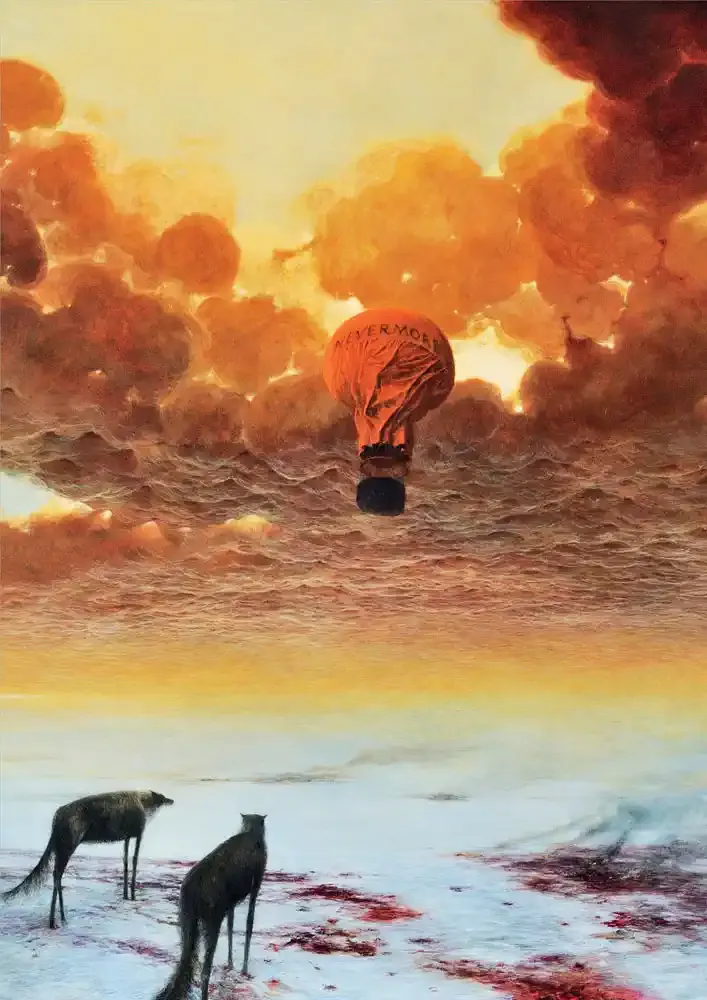
What we see in the painting is a hot-air balloon drifting away, past troubled clouds and into a clear blue sky. On the balloon is written Nevermore, and on the ground two wolf-like creatures are watching it go. Fires burn around them in a desolate landscape. It is a gloomy painting; the environment feels hostile, with something red on the ground that resembles blood.
The painter, Zdzisław Beksiński, was a Polish artist who experienced a life marked by great losses. In the 1990s, his wife Zofia was diagnosed with cancer and died in 1998. This left Beksiński alone with their only child, their son Tomasz. Tomasz grew up and became accomplished in many ways: he was an esteemed music journalist in Poland and responsible for Polish translations of films such as Die Hard, The Terminator, and A Clockwork Orange. However, he lived a troubled mental life and was particularly fascinated by death. In 1977, at the age of eighteen, he wrote his own necrology and distributed it around town. Two years later, he attempted to take his own life.
The painting above was made in 1979, the same year as Tomasz's suicide attempt, and it seems to hold clear connections to this event. It is impossible to know exactly what Beksiński had in mind while painting it, but it can be seen as a desperate plea directed at his son: never again. The two “lone wolves” watching the balloon drift away may be interpreted as father and son, together in a desolate world. “Nevermore”—I imagine Beksinski is begging his son never to attempt this again.
Zdzisław Beksiński is one of the artists that are represented in our Art and the Human Condition email sequence. Learn more about this service by clicking the button below
The Raven — Edgar Allan Poe
The word 'Nevermore' also refers to one of Tomasz’s favourite poems, The Raven, by Edgar Allan Poe, written in 1845. In the poem, a raven enters the study of a student who is lamenting the loss of his beloved. The bird flies into the room and lands on a bust of Pallas, or Athena, the Greek goddess of wisdom. The raven appears able to speak, and the student begins questioning it about who it is, where it comes from, his lost love, and finally, whether he will be reunited with her after death. To every question, the raven gives the same answer: Nevermore.
Eventually, the student knows exactly what answer he will receive, yet he continues to ask questions for which he longs for a different reply. Already fragile at the poem’s opening, he descends into madness by its end:
“And the Raven, never flitting, still is sitting, still is sitting
On the pallid bust of Pallas just above my chamber door;
And his eyes have all the seeming of a demon’s that is dreaming,
And the lamp-light o’er him streaming throws his shadow on the floor;
And my soul from out that shadow that lies floating on the floor
Shall be lifted—nevermore!”
I will not turn this post into a literary seminar, but a slightly deeper look at the poem serves our purpose. In The Philosophy of Composition from 1846, Poe explains that he chose a raven because he wanted “the idea of a non-reasoning creature capable of speech.” Ravens can, arguably, produce speech-like sounds and may be mistaken for responding to human utterances. Yet, as David H. Hirsch points out in his essay The Raven and the Nightingale, this idea is itself paradoxical, since speech presupposes reason. The raven does not intend anything. Meaning is imposed only by the listener.
As Hirsch further argues, it is the lover’s madness—his desperate longing for meaning—that leads him to discover intention in the raven’s sounds, converting noise into speech.
The poem gains further depth through its mythological references. In the Western tradition, the raven often appears as a messenger. In Genesis (8:6–7), Noah sends out a raven to search for land, but it never returns, becoming a symbol of ill omen. In classical mythology, Pallas is associated with the raven, and in Ovid’s Metamorphoses (Book II), the bird was once white before being turned black by Apollo for revealing betrayal. In Poe’s poem, the raven sits atop Pallas’ bust, as if drawing authority from wisdom itself.
The question remains whether the raven communicates anything intelligible at all—or whether the student, driven by grief, constructs meaning where none exists, hearing only what he already knows to be true.
At its core, The Raven is a poem about loss: the despair of irretrievable love and the impossibility of certain knowledge. The student becomes an illustration of solipsism,1 alone in the world, attempting to mask that loneliness by conversing with another being—even if that being is, in essence, himself.
A Disturbing Scene
The title of the painting is curious. Most of Beksiński’s works are untitled, so when he does choose a title, it is likely to carry meaning. I have tried to make sense of AB79 without much success. “79” presumably refers to the year of Tomasz’ suicide attempt, but the “AB” remains obscure to me.
I find this painting deeply disturbing—honestly, in a way that I need. I cannot imagine the psychological pain Tomasz lived with, but I can understand something about the fear of living as a father who might lose his son. This fear is not part of my daily life, but fatherhood has made me realise what an unimaginable pain such a loss would be.
And being a father has also made me aware of my own shortcomings. I get angry over things I should not. I contribute to misunderstandings that could have been avoided. I sometimes undermine my children’s perfectly reasonable arguments simply because I want to be right or because I do not want my decisions questioned. That is not fair play. My children seem to forget these moments easily, but I do not. I feel a persistent need to do better.
The painting reminds me of what I have but also of how easily meaning can turn against us. Like the student in The Raven, I actually sometimes find myself tempted to search for signs, for assurances, for answers that cannot be given.
As a father, I understand this temptation all too well—the desire to read intention into silence, to demand certainty where none exists. Love wants guarantees; life offers none. And yet we continue to ask, knowing what the answer might be, because not asking feels even more unbearable.
In Poe’s poem, the raven never moves, never explains itself, never offers comfort. It simply remains. Beksiński’s balloon, by contrast, disappears into the sky. But the effect is similar. Both leave us alone with our interpretations, with the meanings we project, and with the quiet responsibility of living despite what we fear we already know.
Tomasz’ life did not improve, at least in his own eyes. On Christmas Eve 1999, he succeeded in taking his own life at the age of forty-one. He was found in their home by his father the following day.
Notes & References
1 Solipsism in philosophy is the view or theory that the self is all that can be known to exist. Read more about it in this article at the Internet Encyclopaedia of Philosophy.