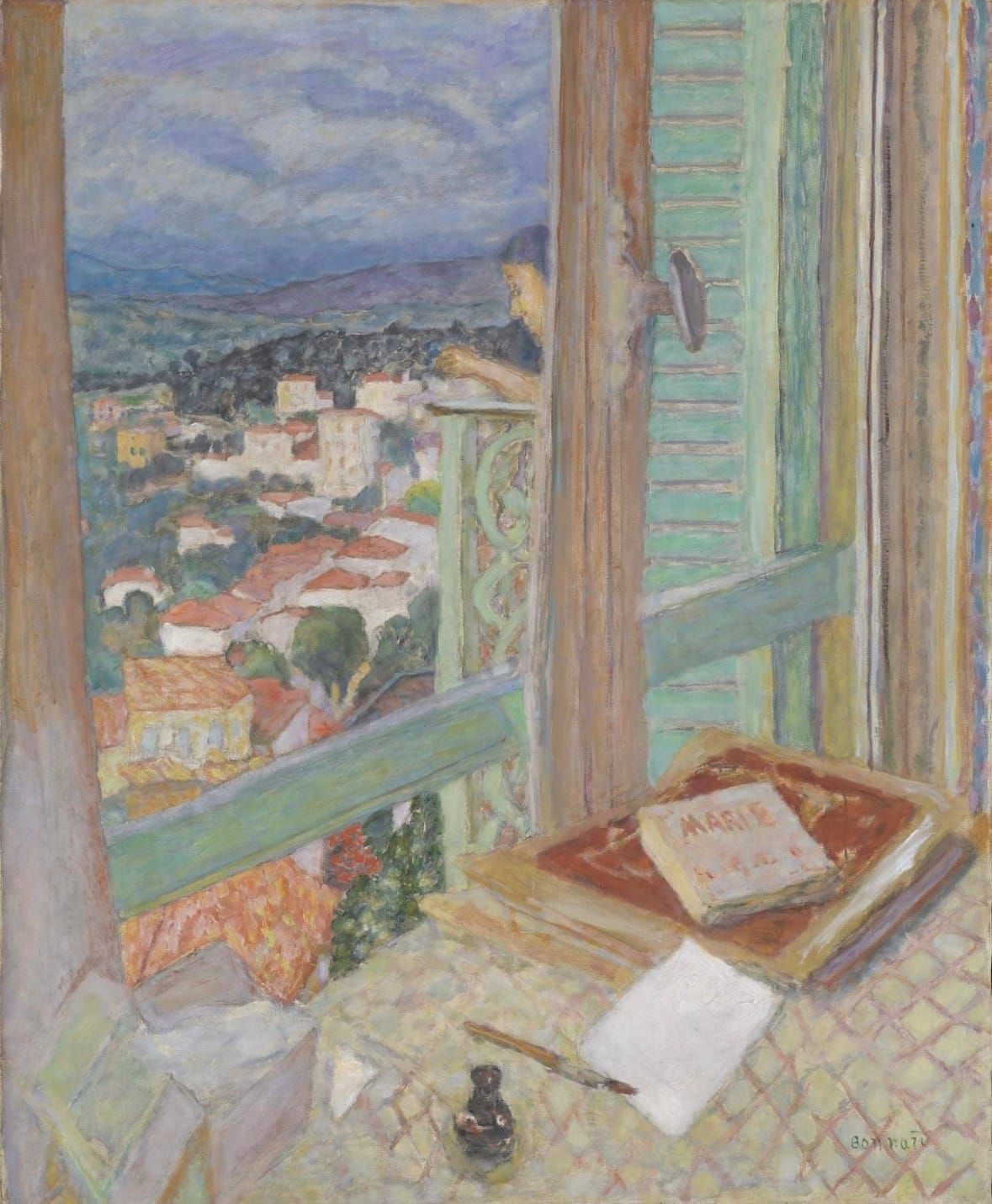

Let's dive right into the painting. The image seems to show an interior seen from close by: a table, a chair, papers, a pen, an ink bottle, a book or magazine, and a window looking out over a sunlit town, hills, and a wide sky. The scene is domestic and intimate, but it opens outward into a much larger world. There is someone on the balcony, looking down on the town below.
What is striking is the way the picture is divided between inside and outside. The left side draws the eye through the window toward the houses, red roofs, trees, mountains, and clouds. The right side remains inside the room, where the vertical lines of shutters, curtains, woodwork, and the wall create a more private, enclosed space. The table in the foreground forms a kind of threshold: it belongs to the room, but its slanting surface leads the eye toward the view.
The painter of this image does not seem interested in sharp descriptions. The houses outside are almost dissolving into colour, and the objects inside are softly unstable, as if remembered rather than recorded. This gives the image a dreamlike quality. It is not simply “a view from a window”; it is a view filtered through mood, memory, and... what can we call it... inward attention?
Personally, I read the scene as an image of contemplation. The blank sheet of paper and the pen and ink suggest someone who has just been writing or is about to begin. It is easy to imagine that the person in question is the one on the balcony, but we cannot be sure. The window – which in fact takes up most of the image – becomes an invitation to look and let the eyes wander, while the table holds the tools of thought.
If we put it a little abstractly, the painting can be seen as an illustration of the border between life and reflection. It shows a room where one might withdraw from the world, but the world is still there, entering through the window as light, colour, and memory. From the elevated position of the room, the person living there has a view over the town below, making it possible to contemplate life from a distance. Perhaps the image suggests that looking is never passive: to look out is also to look inward.
The Artist
Pierre Bonnard was a French painter, printmaker, and designer, born in 1867 and active until his death in 1947. He is often associated with Post-Impressionism, Symbolism, and especially Les Nabis, the avant-garde group he helped found in the late 1880s. The name Nabis comes from the Hebrew word for "prophets", and the group saw itself as announcing a new kind of art: more decorative, subjective, and expressive than academic realism.
Bonnard’s early work was strongly shaped by Japanese prints, which were very influential in Paris at the time. He liked flattened spaces, unusual viewpoints, cropped compositions, patterned surfaces, and intimate everyday subjects. Rather than constructing paintings through traditional perspective and modelling, he often let colour, pattern, and surface carry the image.
What makes Bonnard especially interesting is his devotion to ordinary, private life. He painted interiors, meals, gardens, windows (as is the case in the painting above), bathrooms, tables, mirrors, and views from balconies. These subjects might sound modest, but he depicted them from his own perspective. To Bonnard, a room is never just a room, so to speak; it becomes a field of colour, memory, perception, and emotion.
Colour and light play a major role in Bonnard's art, but he was less interested in capturing light objectively than in recreating how light feels when remembered. This separates him from the Impressionists, even though he learnt much from them. Impressionism often pursued the fleeting appearance of a moment; Bonnard pursued the afterimage of experience.
I must say, having learnt about this fleeting memory aspect of his paintings, I view his work differently. Taking into account what Bonnard was trying to do in his art actually brings something additional; I find it pleasing to view his work in accordance with his intentions. His work is not so much postcards but more like memories of past incidents, and this dreamlike quality becomes a new layer through which I see his work.
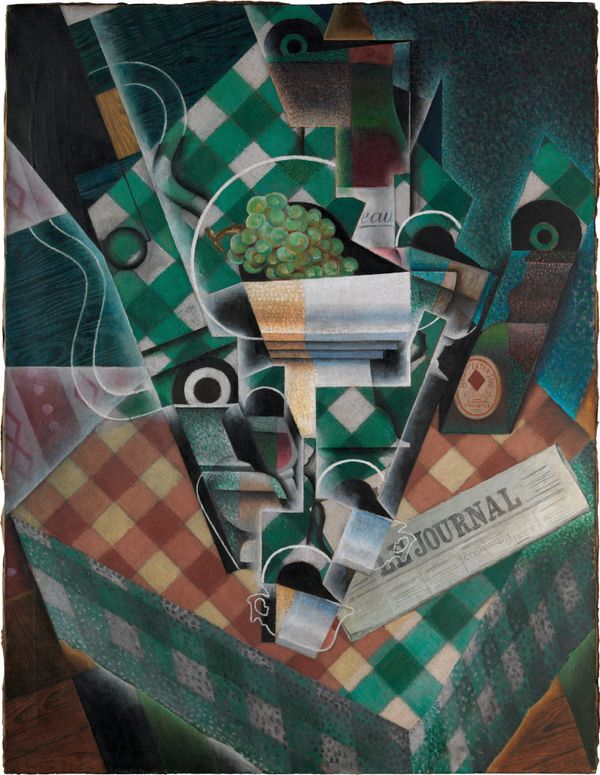
He remained somewhat apart from the most radical modernist movements of the early twentieth century. While Pablo Picasso and Georges Braque were developing Cubism, Bonnard continued to explore colour, memory, and domestic perception. For that reason, some critics have seen him as less modern. But later generations have increasingly valued him precisely because his modernism is quieter: not a break with the visible world, but a transformation of it from within.
Sometimes changes occur subtly.