
Bazille's Studio & The Origin of Impressionism
There is something about the turn of the 19th century that fascinates me. Especially intriguing is it to try to imagine what happened when now famous people met.
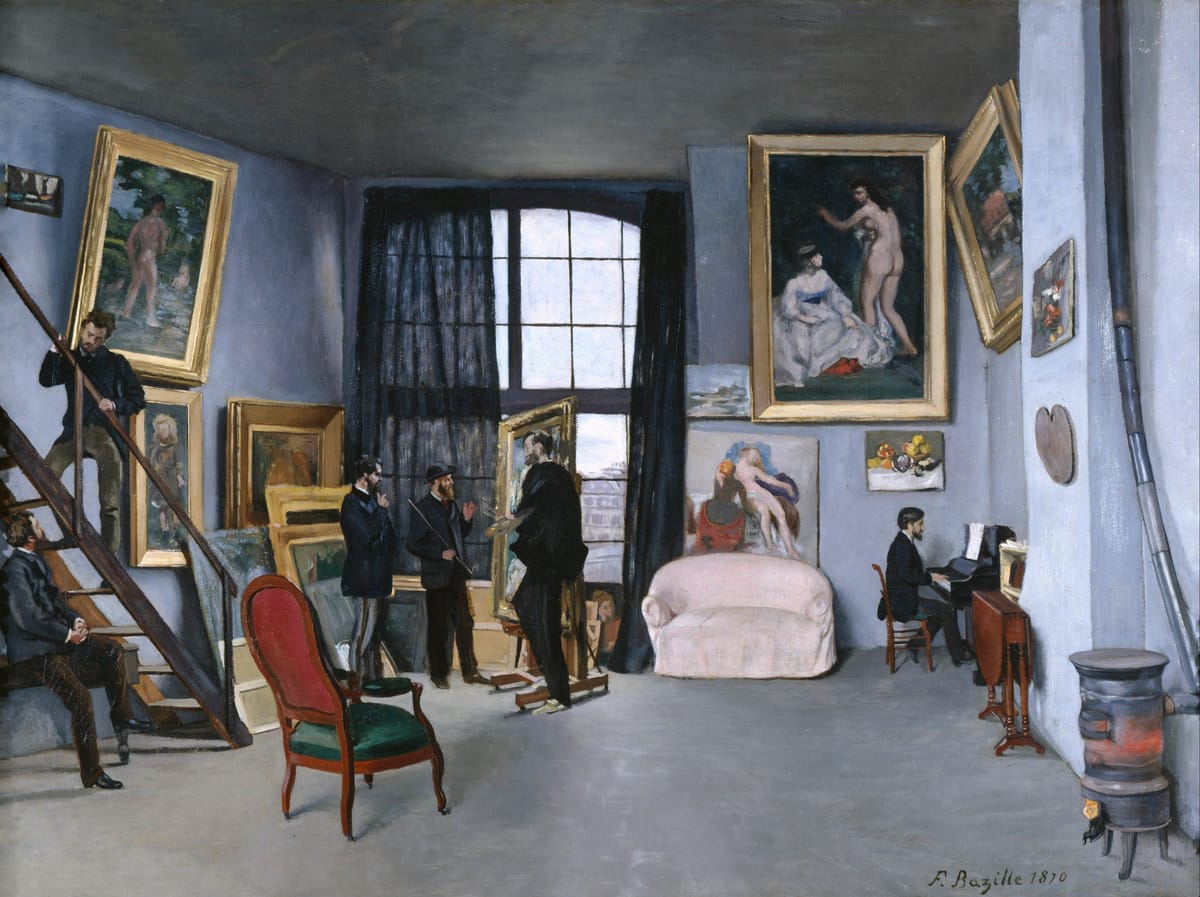
Frédéric Bazille (1841-1870) was a French painter, whose life I have briefly presented in an earlier post here on the site. I therefore take the liberty of jumping straight to the painting at hand.
The painting «Studio in Rue de La Condamine» was completed by Bazille in 1870. It is an oil-on-canvas painting that (obviously) depicts Bazille's studio in Rue de La Condamine, Paris, where he worked and lived with fellow artists such as Pierre-Auguste Renoir and Claude Monet. Bazille himself is placed in the center of the painting, in front of the easel, holding a palette. However, he did not include himself in the scene. "Manet painted me in," he stated in a letter to his father. Édouard Manet is the one with the hat looking at the painting on the easel. On the right, Edmond Maître, a friend of Bazille, is seated at the piano.
The painting shows the interior of the studio with various objects and furniture, including a table, a couch, a guitar, and a painting on an easel. The light entering from the window illuminates the space, creating a sense of depth and atmosphere. The painting on the easel has been identified as "View of the Village", and above the sofa is an unfinished version of "La Toilette", the painting I wrote about in the aforementioned earlier post here at Naive Notions. Further, there are paintings of Renoir and Monet also hanging on the walls, and all paintings on display here had at some point been rejected by the official Salon in Paris. And the rejection from the Salon played a major role in the establishment of Impressionism as an independent art movement, as we shall see below.
«Studio in Rue de La Condamine» is one of Bazille's most well-known works and is considered a masterpiece of Impressionism. The painting captures the essence of Bazille's personal space, his studio, and shows his creative process at work. The use of light and shadows creates a sense of depth and atmosphere, while loose brushstrokes and vibrant colours convey a sense of energy and spontaneity.
The Impressionists Emerging
I honestly get a little starstruck when I look at the painting. Here, in this room, are several of the world's most renowned artists gathered in unstrained conversation. What, I wonder, were they talking about? Were they discussing some artistic feature that subsequently proved to be a major influence? What were their personal views on the artistic works at the time? As the paintings were executed exactly when the Impressionistic movement—as a reaction to the hegemony of the academic art tradition—was starting to emerge, what hope did they hold for the future? How did they feel about the harsh critique that some of their work was getting from the Academy, and how did they cope with the refutations from the official Salons?
It is hard to know, of course, how the conversation developed as they were standing here, but it appears that the emerging impressionists struggled with their conviction and self-belief. The Salon had been the place to display your work as an artist, and the artists that got refused by the committee had nowhere else to go. The somewhat older artist and acquaintance Eduard Manet had tried to get into the Salon with his paintings, but his works had not passed the critics. Manet painted in a stylistic combination of Delacroix and Gustav Courbet and made images with a lot of the right connections to academic art. Still, some features of these images constituted a profound break with the canonised ideas of the time, and even if his works were excellently executed, they still did not pass. The references in his art were too obviously pointing at ideas and attitudes not part of the Salon’s frame of reference.
However, Claude Monet and his group were inspired by this, as they also did not stand a chance in the Salon. In the year 1866, in particular, many paintings were refused by the academy, and there was a growing dismay with the Salon’s choices. The protests even reached Napoleon III, who gave orders to arrange an alternative exhibition, Solon de Refusé, the salon of the refused. Still, the artists, later known as impressionists, wanted to go further. They dreamed of displaying their work in a separate exhibition, and they found an advocate for this in a man named Paul Durand-Ruel. Durand-Ruel was an art dealer who had grown an unmovable belief in these artists and promoted their work wherever he could. Durand-Ruel’s father had found it possible and enriching to support the so-called Barbizon group of artists, and Durand-Ruel followed in his father's footsteps by wanting to promote new artists in his own generation.
Note on the Barbizon group
The Barbizon group was a French group of painters, whose name they took after the village in which they worked, that—in many respects—kick-started Impressionism. The artists in the group provided an alternative to realism, which arose in the context of the dominant Romantic Movement of the time. They took advantage of the small tubes of paint that were entering the market by leaving the studios and moving outside to paint in the open air. Many worked using looser brushstrokes and a freer style than was traditional in academic painting. These experiments had a profound impact on the work of the Impressionists, who travelled to Barbizon as young artists to learn from the members of this school.
However, the new artists Durand-Ruel sought had to align in style with what his existing customers wanted to buy, and after searching near and far, he found them in Claude Monet and Camille Pissarro. He commissioned many of the works of Monet, Pissarro, Renoir, Alfred Sisley and others, and he also provided monthly allowances in order for them to provide more art. Durand-Ruel had a great understanding of where progress would lead, and he recognised that the new wealth and the emerging bourgeois social class would be interested in buying art that differed from what their parents had purchased. He even suggested to the artist that they should paint pictures in a smaller format, suitable for people with more modest-sized flats. In this way, the technological development of the end of the 19th century provided two distinctly different but intertwined developments that affected the art world: On the one hand the general development gave rise to new societal classes with new tastes for art. On the other hand, new technology provided inventions that made it possible for artists to leave their studio and paint elsewhere. As new technology made it possible to produce paint in tubes and not only in cans, the artist was able to bring their paint outside, set up their easel, and easily administer the painting process away from their studio. Hence, the development at the time provided both a new need for art and the means to meet it.
The Exhibition of the Impressionists
Will Gomez, in his excellent book, "What are you looking at? 150 years of modern art in the blink of an eye",1 makes a compelling description of how the artists reacted after the first impressionistic exhibition. He describes their conversation four years after the painting above was made, just after the first Impressionistic exhibition in 1874.
Camille Pissarro, Claude Monet, Alfred Sisley, Pierre-Auguste Renoir, and Paul Durand-Ruel were gathered at a café in Paris, contemplating the opening of the exhibition the night before. They got hold of a newspaper; it was 25 April 1874, and the paper was Le Charivari. They took turns at reading the review of the various paintings that the newspaper’s critique provided and of the exhibition as a whole. The article was called The Exhibition of the Impressionists.
The art critic responsible for the article, Louis Leroy, employed a particular narrative in this review, making it a conversation between himself and a fictitious Mr. Joseph Vincent, a "landscape painter, pupil of Bertin, recipient of medals and decorations under several governments". They walk and talk their way through the exhibition, commenting on everything they see. Or mainly, they laugh at the paintings, mocking them and making sarcastic remarks.
And when they arrive at Monet's now world-famous painting:
‘Ah, there he is, there he is!' he cried, in front of No. 98. ‘I recognise him, papa Vincent’s favourite! What does that canvas depict? Look at the catalogue.'
‘Impression, Sunrise.'
‘Impression—I was certain of it. I was just telling myself that, since I was impressed, there had to be some impression in it … and what freedom, what ease of workmanship! A preliminary drawing for a wallpaper pattern is more finished than this seascape.'
Leroy’s critique of the exhibition in the newspaper was devastating, and our group of artists that was reading aloud to each other sank further down in dismay as the verdict was being contemplated. Their exhibition was meant to be an alternative to the official Salon in Paris, where independent artists could display their work without the Academy's unfair judgement, but they failed to attract the public. At least, they had failed to capture the public's attention in the way they wanted. Many of the visitors that actually came to investigate what this new group of artists had mounted had been seen laughing and joking on their way out. After a month, the exhibition had to close, with substantial financial loss. The artists had to split the bill between them, although some took a larger portion of the expenses than others.
Aftermath
Leroy, then, must have thought himself to be correct when the exhibition closed so disastrously, but in fact his article was the one that coined the term "Impressionism". And the year after, a new impressionistic exhibition was arranged, and the year after, yet another. In fact, it was not until the third iteration of the exhibition that the group of artists called themselves impressionists. Prior to this, their name had been something like The Anonymous Society of Painters, Sculptors, and Printmakers.
The line of impressionistic exhibitions grew in popularity, as did the galleries selling impressionistic art, which had started to dominate the market. Over the years, a variety of artists showcased their work, but the movement's founders were not always present. The last exhibition in 1886, however, saw a return of many of the biggest names, and Degas, Cassatt, Zandomeneghi, Forain, Gauguin, Monet, Renoir, and Pissarro all exhibited.
Even though Paul Durand-Ruel and the Impressionists had to endure some hard times, it all paid off in 1888, when Durand-Ruel administered an exhibition in America. Here, the new art was in high demand, giving the Impressionists their definitive breakthrough.
Even though Leroy himself worked as an artist in his own right, it was the aforementioned infamous article, his critical perspective, and his mockery of what became an immensely influential and cherished artistic movement that most prominently stuck to his name. Of course, his view on the new art was in alignment with the majority of the public, but I find it fascinating that Paul Durand-Ruel, in fact, managed to recognise something in this novel perspective and technique that eventually resonated with the views of most of the western art world.2
Notes & References
1 See more informastion about this book on Amazon
2 Read more about Durand-Ruel in this excellent article from The Guardian