
The Start of Philosophy
Some paintings are just illustrations. This is one such painting.
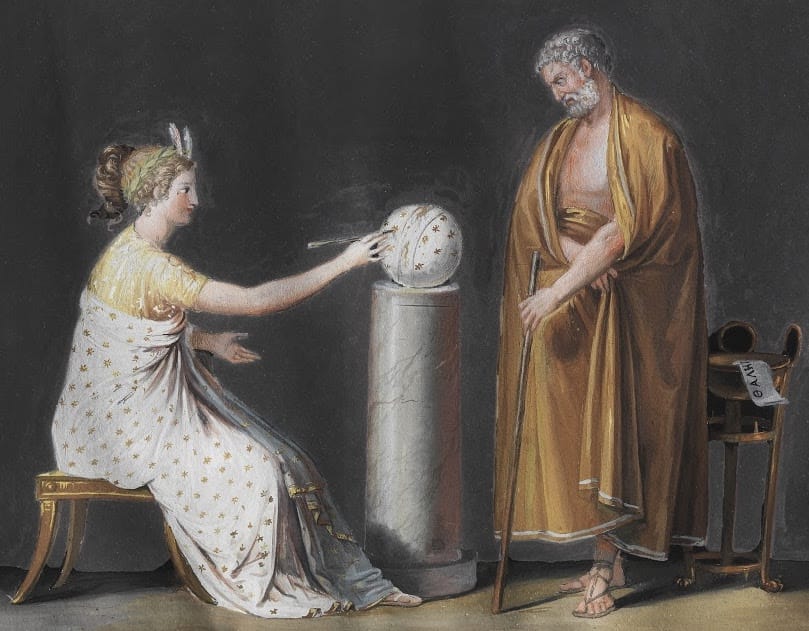
The painting in this post is presented here at Naive Notions not for its artistic qualities but as an excuse for writing about the man widely regarded as the first-ever philosopher: Thales of Miletus.
When one finds philosophy interesting, as I certainly do, it is of interest to know something about where it all started and what the initial outset of philosophy looked like. One thing philosophy itself has taught me is that when we are eager to understand something, we need to investigate its origin.
Antonio Canova
Before we go on to Thales, however, we are obliged to say something about the artist. And I’ll keep this introduction short because Antonio Canova was no great painter at all; he was a great sculptor.
In fact, the Italian artist Antonio Canova (1757-1822) is considered the greatest Neoclassical sculptor of the late eighteenth and early nineteenth centuries, with his The Three Graces as one of his absolute masterpieces. Along with the painter Jacques Louis David, he pointed to a new aesthetic of clear, regularised form and calm repose inspired by classical antiquities. He was also renowned for his carving abilities and the refinement of his marble surfaces, which seemed as supple as real flesh.
Jacques Louis David is one of the artist that is represented in our Art by Email sequence. Learn more about this service by clicking the button below
Still, today, I present a painting by him, and the full title is «Urania, the Muse of Astronomy, Reveals to Thales the Secrets of the Skies». In the picture, two people are present, and the title tells us who. Seated, we see Urania, the goddess of astronomy and stars, attributed with a globe and a compass. Urania was the daughter of Zeus by Mnemosyne and also a great-granddaughter of Uranus. The other person, standing and looking a little perplexed, is Thales of Miletus, who is our chief concern here.
Thales of Miletus
Thales is widely regarded as the first philosopher in the Western history of philosophy. Doubts have always existed about whether Thales wrote anything, but several of the earliest philosophers have credited him with writing. We don’t know if later philosophers, such as Aristotle and Plato, had any written texts from Thales, but they seem to quote him in their own texts. Still, what we know about Thales, we know from others.
Thales from Miletus lived from c. 620 B.C. until c. 546 B.C., and this, then, is when philosophy—as we have come to know it—started. However, the notion that Thales was the one to start the line of philosophical thought is not new. Aristotle, the major source for Thales’s philosophy and science, identified Thales as the first person to investigate the basic principles, the question of the originating substances of matter and, in effect, constituting the school of natural philosophy.
Thales was interested in almost everything, investigating almost all areas of knowledge; the fields that we now know of as philosophy, history, science, mathematics, engineering, geography, and politics were all under his scrutiny. This, however, was not unique in the early days of philosophy. Subjects, or fields of knowledge, as we know them today, had not been invented, and thus, the world was experienced as one whole entity, where everything was connected to everything else. These were not fields in their own right but just different parts of the lived life.
Water As The Main Substance
Through his investigation, Thales came to conclude that the basic substance of the world was water. Thales may have observed his surroundings and tried to identify what it all could come down to. As water was "everywhere" and needed also for plants and life to flourish, it is easy to imagine how this substance was seen as prominent in the world. And if one substance should be pointed at for providing the main building block for the world—Thales may have thought—water would be it. For his hypothesis to be credible, it was essential that he could explain how all things could come into being from water and return ultimately to the same originating material. Such a theory was touched upon in the dialogue Timaeus by Plato, where a cyclical process was described. In this hypothesis, water evaporates and subsequently comes down again from the sky. It is possible that Timaeus in his dialogue here refers to Thales, indicating that he, in fact, had arguments for his idea of water as the primary substance.
Further, water was also part of the explanation for the earth’s foundation. The earth, Thales thought, was a flat disc1 floating on water, just like wood. Floating islands were known in Ancient Greece, and as water had this prominent position in Thales worldview, it must have made sense to make it the very foundation as well for the earth. Through this hypothesis, he was also able to explain earthquakes, as a result of the sea’s roughness. When waves increased beneath the earth, the earth would crack, making disruptions in the ground.
I wonder, however, what it was like to really believe that the earth was floating around on this large sea. I wonder what he thought the sea itself was resting on, or what was beyond the borders of the sea. He had, perhaps, the same questions as we have when we think about our expanding universe and the borders across which it expands.
Departing From the Purely Mythological
The point, though, is not whether Thales was right or wrong in his assumptions. What Thales in substance did through his investigations, was to take the first steps from an explanation of the world derived from the Ancient Greek mythology, towards a more “scientific”, or natural, understanding. This is, in fact, not a trivial step to take. The Ancient Greek deities were—in the views of the citizens—responsible for providing rain, sun, fertile ground, and other things necessary for sustaining life. In such a world view, the main objective would be, by all possible means, to keep the gods satisfied. Whether the gods actually were satisfied by the sacrificed gifts, and thus provide the necessary components for a sufficient harvests, was totally out of their control. Thales, however, planted the first seeds of a more informed, less arbitrary and uncontrollable world. A world with a more direct and knowledgeable relationship between cause and effect.2
Further, it was not only the earth that Thales investigated. He turned his mind also to the skies, and he is—astonishingly—attributed with having predicted a solar eclipse. How he could have done so with such success with the available means for observations is a mystery. Still, within the specified time span—even though this was a time span of several months—this eclipse took place, just as he had said.
Thales must have enjoyed a great reputation, as many discoveries and much wisdom is (more or less correctly) attributed to him. He is said to be able to calculate the height of the Egyptian pyramids3, and the distance of the ships at sea from the shore.
Nonetheless, many were critical of this new business that Thales and, subsequently, others were starting to conduct. They were looked upon by their fellow citizens as only walking around, thinking, pointing, perhaps, and speculating about the world, instead of actually doing something useful. The story goes, however, that Thales set up a plan for proving these critics wrong and illustrating how thinking and investigating the world actually could be beneficial. After deducting that the olive harvest that year likely would be great, he bought all the olive presses in the area at a low price during summer, only to rent them out again at a higher price in the autumn when the need and demand for such presses were high. This provided him with great sums of money, and he had done so without any manual labour; all this money came purely from his intellectual activities. The story has it, though, that he didn’t care for richness; his only interest was to prove his point.
What Thales Teach Us
So, then, this was where it all started. It is strange, I think, that at this point, people—for some reason—just started to look at the world around them in new and different ways, giving rise to new questions and perspectives. This must have looked like a strange endeavour indeed when the potential benefits of investigating the world in a more systematic manner were yet to be experienced. I have to admit, from my philosophy classes at the university when I was a student, Thales has always seemed like a strange and uninteresting person to me. Obscure, with nothing to teach us today. Thinking about it now, however, I find things to be said for Thales. Even though he was probably not alone in starting this philosophising activity, he has become the symbol of it. And even though he—of course—could not foresee how this "thinking activity" would develop, he found it interesting to engage in something completely alienating from what was the custom at the time.
What he sought, probably, was not merely to accept the world, but to understand it, to explore it, and to figure out how things were connected. He did not settle for the common routines of everyday life and the vague and unwarranted explanations of the past generations. I think, in our time—even though we have scientifically explained much of our natural world—our complex social, digital, and democratic worlds ignited in many of us a need for understanding. Contrary to the situation for Thales, who had the possibility of rejecting past explanations, we, in fact, have nothing to reject, as the increasing complexity and speed of change constantly creates new conditions for social, political and bureaucratic interactions.
What we can learn from Thales, I think, is that knowledge puts us in a position where we are in charge; knowledge makes us able to understand how things are connected, and it makes us able to change them. Our models for explanation determine what we see as possible, and the more actual knowledge—and here I do not mean vague ideas and biased opinions, but grounded and warranted knowledge—we put into these models, the more we can use the models for expanding our surroundings. I think this is true in science, in politics, and in our everyday life.
Notes & References
1 It is actually disputed whether Thales saw the world as flat or spherical. Through his astronomical observations, he could have come to conclude that the world was round, a view that was—in fact—not uncommon among the Ancient Greek philosophers.
2 Thales, however, did not disregard the gods. On the contrary, he believed that the gods were omnipresent, and as a result of this, all matter had some aspect of life in it. He thought that by understanding the fundamental principles of nature, people would actually get to know and understand their gods better.
3 One of the geometric theorems that Thales is said to have discovered, is that a triangle is determined if it’s base and the two angles at the base are given. This way, Thales may have been able to calculate the height of these constructions from the known numbers.