
The Great Red Dragon and the Woman Clothed with the Sun
William Blake is an enigmatic person to me. I have to confess, I initially thought he was foremost a poet, but it turns out he executed some rather mysterious pictures. It is hard to imagine how a life such as his must have been.
William Blake (1757-1827) was a British poet, painter, and engraver. He was one of the strangest characters in English literature and art, misunderstood by his contemporaries, the first big romantic, and, at the same time, a genius that resists classification. Many of his smaller poems, like The Tyger and Jerusalem, are known by many, but his bigger works are quite difficult to understand.
Blake lived almost all of his life in London, impoverished and in modest circumstances, at best. As a child, he was withdrawn and experienced visions. His whole life he felt surrounded by heavenly creatures. Artistically, his career started when he was ten years old and sent to a drawing school. Four years later he started as an apprentice in engraving.
In 1781, Blake took a trip to Battersea to recover from a failed marital attempt that had upset him. Here, he met Catherine Boucher, who almost immediately recognised her future husband in him, and on 18 August 1782, they were married. The couple did not have any children; however, they had a long and—seemingly—productive relationship in spite of this. Catherine started to work together with Blake on his projects, and she remained his assistant throughout his life. In fact, together they administered every process of Blake's publications, down to producing the colour and even the ink with which Blake wrote. The only thing they did not make themselves was the paper.
William Blake investigated different forms of expression. His first poems, Poetical Sketches, from 1783, were published in an ordinary fashion. After this, Blake developed his own style, a merging of his writing with visual media. All of his later poetic works he engraved into copper plates, added ornaments and illustrations, and he finished these visual-poetic expressions with watercolours.
Blake’s dedication to his personal art was ambitious and uncompromising. Through his art, he gave expression to his deeply held beliefs about the fallen condition of humanity, the pervasiveness of evil and oppressive forces, and states of spiritual and moral crises. The fallen conduct of man, in respect to ethics, morality and a suitable way of life, Blake blamed on the Enlightenment. This was not uncommon; however, many saw the scientific progress and the more fact-based reasoning of the enlightenment as a threat to the traditional way of life.
An Alternative Universe
Many of Blake’s works do not make any reference to reality as we commonly think about it; instead, it is an alternate universe that emerges in his art. Blake’s universe was driven by his extensive reading of sources like the Bible, different kinds of mythology, and the poet John Milton (1606-1674).
When researching Blake for this post, however, I suspect that his choice of litterateur was guided by some features in his personality, so to speak, in that he at an early age started to see visions of heavenly creatures. At age ten he saw “a tree filled with angels, bright angelic wings bespangling every bough like stars”. To really believe this sight, to know that these kinds of beings exist, of course, must have affected him deeply, and this is what is passed through in his art.
Furthermore, more ordinary, or at least earthly, events that were having an impact on London in the final years of the 18th century—such as the American and French Revolutions, internal uprisings against class inequalities, and the transformation driven by the Industrial Revolution—were interpreted by Blake in a mythological manner. Blake regarded such political and social shifts with suspicion, believing they foretold a coming apocalypse and the subduing of humanity through new civic and technological orders.
Still, Blake was a revolutionary thinker and poet who demanded rights for the individual to express him- or herself freely. His mysticism is evident in many of his works, but most prominently in titles such as The Book of Thel (1789), The Marriage of Heaven and Hell (around 1791), The Song of Los (1795), and Milton (around 1804–1808). In these works, colossal visions are present, partly with biblical themes, but in stark contrast to both conventional Christianity and contemporary rationality.
Blake became acquainted with some artists of the day, such as Mary Wollstonecraft and Percy Bysshe Shelley, but did not secure any steady supporters. However, the senior civil servant Thomas Butts commissioned work from Blake, and he regularly advanced Blake money to pay for future work. The patronage reduced from around 1816, and even though Butts purchased some of Blake’s work up until around 1827, Blake died in financial distress.
However, after his death he became a source of inspiration for new generations of artists, especially the British Pre-Raphaelites and later the Surrealists. During the 20th century, Blake's reputation grew, and he was established in a place next to J.M.W. Turner (1775-1851) and John Constable (1776-1837) as one of Britain’s greatest artists.
The painting: An Epic Battle
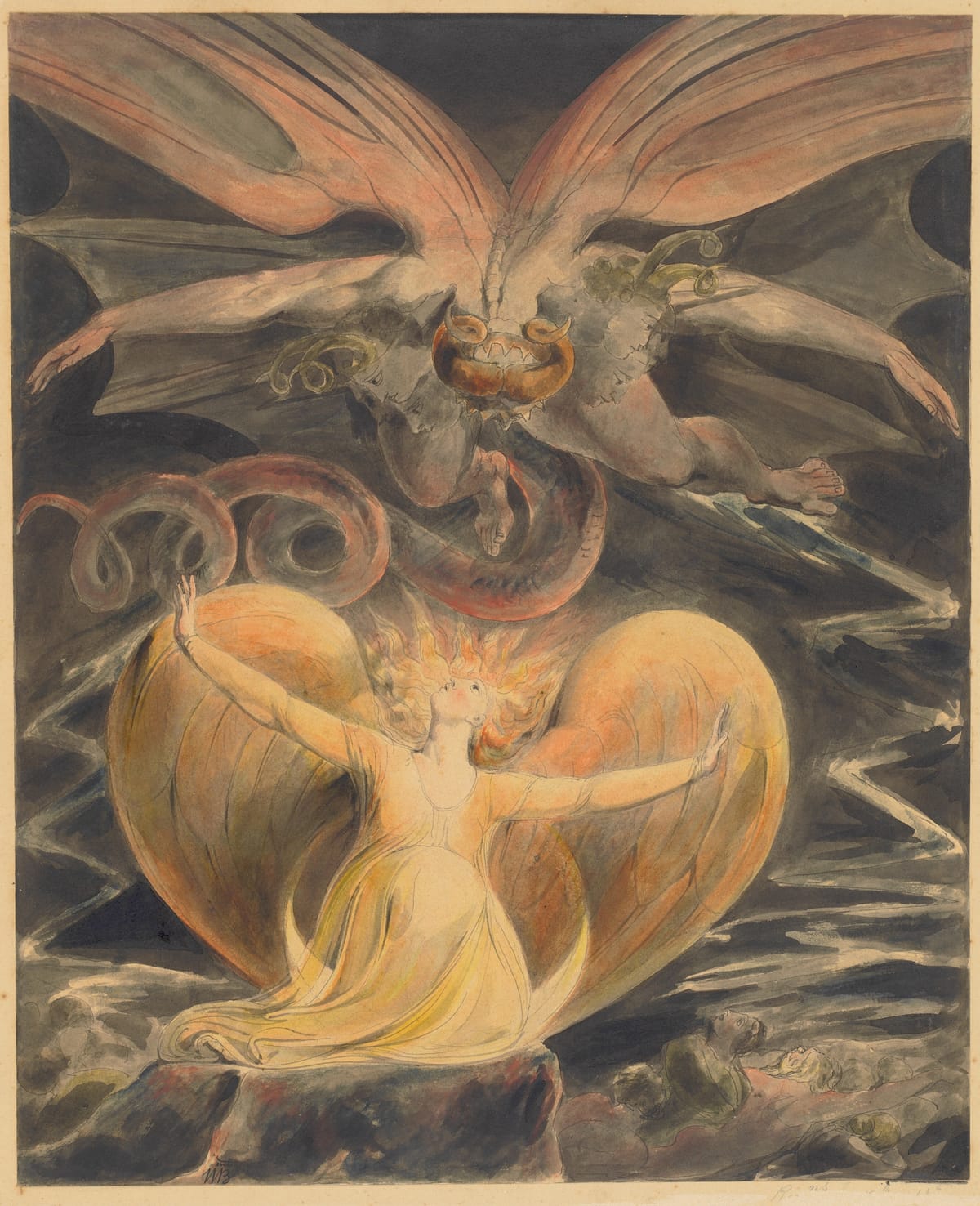
What we see in the painting is (obviously) some kind of dragon, or perhaps a demon, descending on a woman, who looks like an angel, with bright yellow colours and her wings spread out. It looks dramatic, and it is: there is nothing less than the fate of humankind at stake in the battle.
The painting conveys battle, with its lightning-shaped formations on the side and the long tail of the dragon curling above the woman, ready to assist the dragon in his attack. The woman stretches her arms apart, as if she were creating a shield, protecting the humans on the ground beneath her.
Looking a bit closer at the painting, there are a couple of more human-like faces attached to the dragon, faces that look anguished. These human heads have horns attached to them, as if they have been consumed by the dragon and are now at his service. The battle—it seems—is of epic dimensions.
Book of Revelation
The motif is biblical, taken from the book of Revelation, the final book of the New Testament, and is part of a series of engravings that Thomas Butts commissioned from Blake to represent the books of the Bible. The series conveys warnings to Christians to maintain and guard their faith. Blake's painting illustrates passages that describe «an enormous red dragon with seven heads and ten horns and seven crowns on his heads» who descends upon «a woman clothed with the sun, with the moon under her feet and a crown of twelve stars on her head».
The woman protecting the humans is with child and is about to give birth to a boy, who was destined to rule all men with an iron rod, humanity’s hope and salvation. According to the story, the dragon tears down one third of the heavenly stars and throws them down to earth. He then took place in front of the woman when she was giving birth, but the child was pulled up to God, and the dragon could not get his hand on him. Then, a war broke out between the Archangel Mikael and his angels against the dragon and his angels. The dragon was defeated and thrown down «because there was no longer room for them in the heavens».
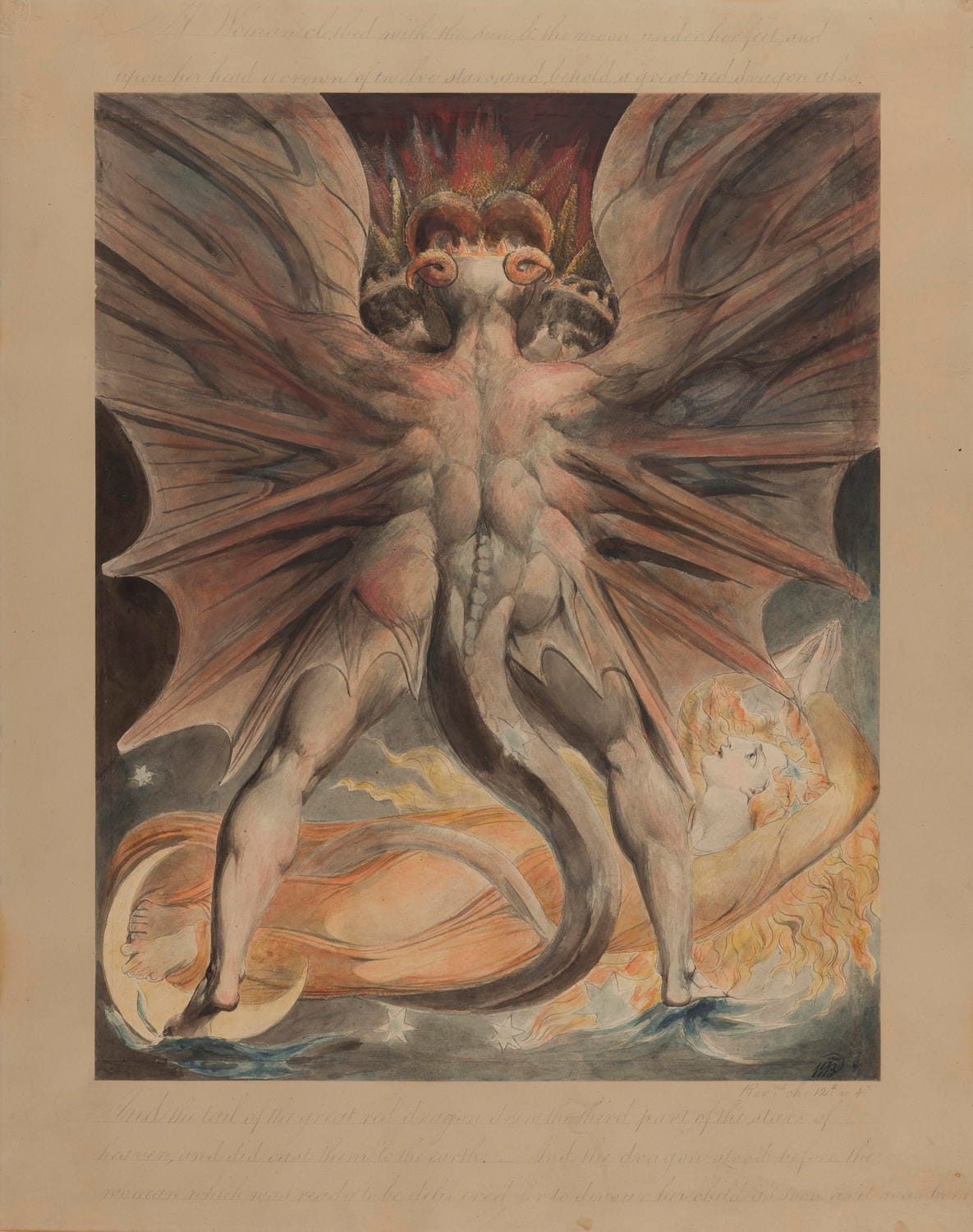
Blake’s motifs are deeply personal, and in this second engraving we see the dragon as he has taken his place in front of the woman in labour, to destroy the baby once it is born. The muscular back and wings of the dragon fill most of the frame, a testimony, perhaps, to the immense power of evil and a reminder of the forces Christianity has to confront.
As commissioned pictures for a book, these engravings can be disregarded as mere illustrations of a mythical tale. As part of a deeply experienced personal worldview, however, they become something much, much larger.