
The Gates of Dawn
I find this to be a highly intriguing painting! The extremely confident protagonist is actually quite inspiring, a painting—I think—to keep in mind when times are low. Each beginning entails new hope, new horizons, and new possibilities.
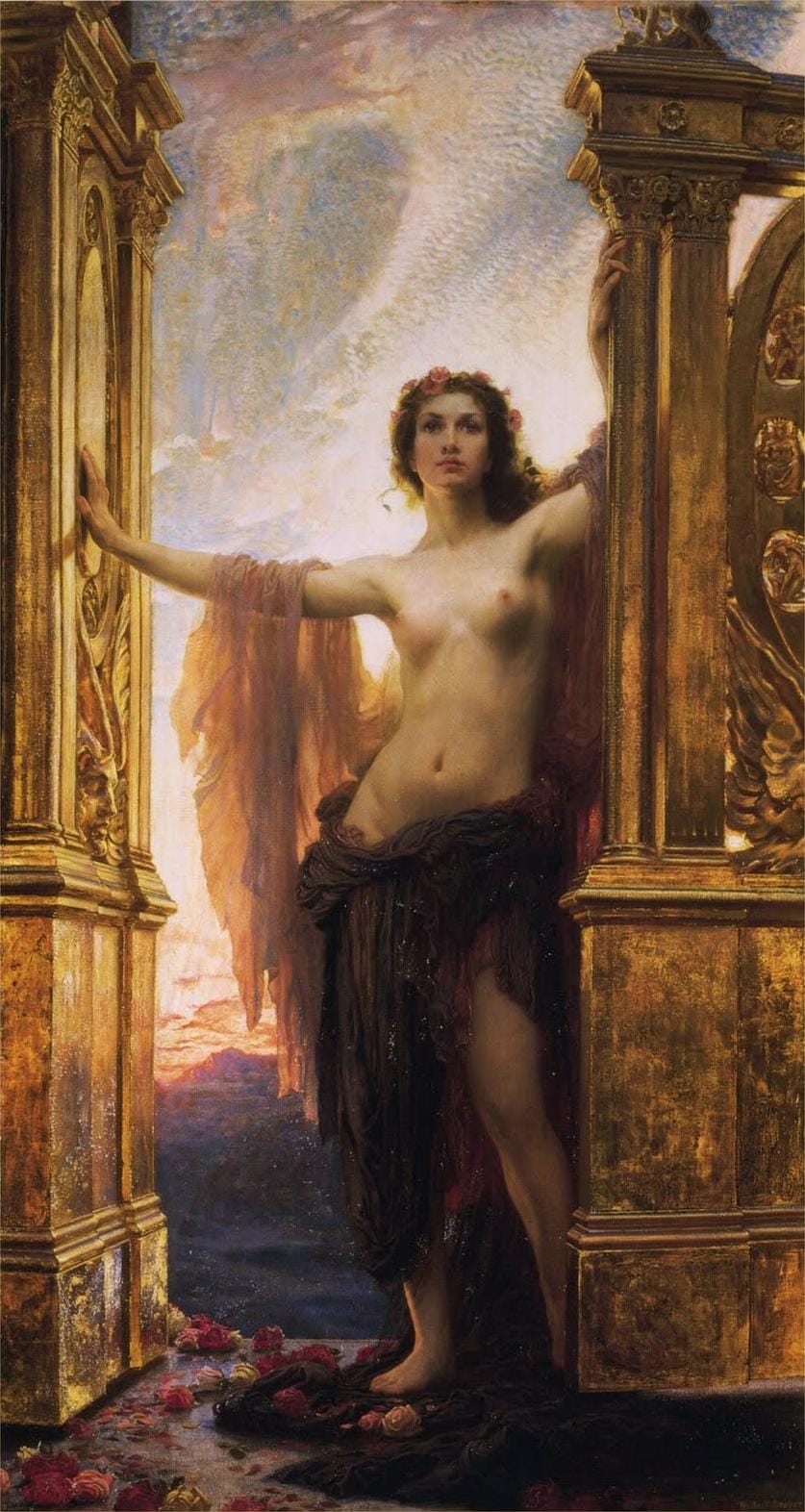
The Artists, in Very Short Terms
Herbert James Draper was an English Victorian painter and lived from 1863 to 1920. His paintings often depict grandiose and sensual motives from mythology and old legends. Draper achieved considerable success in the years around 1900, but despite his technical skills, he subsequently fell out of fame when figurative art went out of fashion.
Aurora, The goddess of Dawn
We see a (rather beautiful) woman in the painting, but who was she really? According to legend, Aurora was the daughter of the Titan Hyperion and the Titaness Theia. She was the sister of Helios, the god of the sun, and Selene, the goddess of the moon. Aurora was said to ride her chariot across the sky every morning, announcing the arrival of the sun and the beginning of a new day. She is the equivalent to the goddess Eos in Greek mythology.
Note of the relationship between the Greek and the Roman deities
One of the reasons for Roman and Greek mythology having such similarities is that the Romans, when they had conquered the Greeks, adopted many of their mythological narratives. According to Bertrand Russell, in his History of Western Philosophy, the Greeks were superior to the Romans in almost every aspect of civil life. They had a more developed notion of government, better civil rights, and more advanced and nuanced religious beliefs. There was only one part of the ancient society there the Romans were far beyond the Greeks, and that was in terms of the armed forces. So, when the Romans had defeated the Greek world, they saw the benefits of sustaining the Greek way of life. However, for the Romans, it was essential that the deities had names after the heavenly bodies, and hence, many of the Greek gods and goddesses were adopted by the Romans and given new names.
Aurora was, in fact, often depicted as a beautiful woman with rosy fingers and golden hair. She wore a long, flowing robe and a crown of roses. In some myths, she was said to have wings like a bird, which allowed her to fly across the sky. However, she has been visualised in a variety of ways through the ages. William-Adolphe Bouguereau has painted Aurora1 (1881); Pierre-Narcisse Guérin, Aurora and Cephalus2 (1810); Peter Paul Rubens (1577–1640), Aurora Abducting Cephalus (c. 1636–37); Nicolas Poussin (1594–1665), Cephalus and Aurora3 (1630); Jean-Honoré Fragonard (1732–1806), Aurora Triumphing over Night (c. 1755–56); and Pierre Claude François Delorme (1783–1859), Cephalus Carried off by Aurora4 (c 1851).

In one famous myth, Aurora fell in love with the mortal Trojan prince Tithonus. She asked Zeus, the king of the gods, to grant Tithonus immortality so that they could be together forever. Zeus granted her wish, but Aurora forgot to ask for eternal youth for Tithonus. As a result, Tithonus lived forever but continued to age until he became so frail he was unable to move. Aurora eventually turned him into a grasshopper so that he could continue to sing to her every morning.
In many of the myths that describe Aurora, she is described to possess a well-developed sexual appetite. Tithonus was but one of her lovers; others were Ares, Orion, and Cleitus, but most of all, Cephalus. Accounts of her affair with Cephalus differ, but a common thread is that he was an Aeolian, already married to Procris. Cephalus was kidnapped by Aurora (as referred to in several of the paintings referred to above) when he was out hunting. Despite his apparent resistance, she conceived (depending on the source) anything from one to three sons by him, including Phaethon and Hesperus. She is sometimes depicted as having quite a few sons: Memnon, who was a warrior and a hero; the winds Zephyrus, Boreas, Notus and Eurus; and numerous other lesser-known deities.
There is a lot of detail in these Roman and Greek myths that—to be honest—can be a bit overwhelming. However, at least in my view, all these specifics about consanguinity and origin are not necessary to enjoy the scenes depicted in art. It would be different, of course, if this were my religion and I actually believed in the myth’s explanatory power. Even if I don’t believe—in this case—that Aurora is the reason for the sun to rise every morning (or, to be more accurate, the reason for my place on the earth to turn towards the sun every 24 hours), I find the painting above inspiring, somehow. Some have interpreted the expression on Aurora’s face in Draper’s painting as an outlook for new lovers to consume, but I assume a more moderate explanation. I find Draper’s version of Aurora by far the most interesting of the different variations of the theme that I have encountered, and to me, Aurora is—with confidence—welcoming a brand new day. Or better, she is creating a brand new day according to her wishes. I imagine her as a symbol of hope and new beginnings, as well as a reminder of the passage of time and the cyclical nature of life. When I look at her in Draper's painting, I start to think, yes, everything is possible.
And further, a song by one of my musical heroes, Sting, turns up in my head. "Brand New Day" is a song from the album with the same name and is, to me, the musical counterpart of the painting above. The song is about the possibility of not being defined by broken love but instead embracing the new opportunities that await. If we extract some lyrics:
We're starting up a brand new day
I'm thinking in a brand new way
We can turn this ship aroun’
You go up instead of down
Hope, belief in the time to come, optimism, true love, and prosperity—I think—are conveyed by Draper above.
Notes & References
1 Aurora, or Dawn, was one of Bouguereau’s most acclaimed works. It is the first in a series of canvases representing the four Times of Day: the others were Dusk in 1882, Night in 1883, and Day in 1884. Allegorical representations of the four Times of Day date back at least to the Renaissance period. Bouguereau’s Times of Day are a study in complements and contrasts; when viewed together, they reveal harmonies of line, form, and colour. They exemplify his standards of ideal beauty and feminine grace in the 1880s.
2 Aurora and Cephalus is an 1811 painting by Pierre-Narcisse Guérin, now in the Pushkin Museum in Moscow. Measuring 251 × 178 cm, it illustrates lines 661-866 of Book 7 of Ovid's Metamorphoses and is a version of the artist's 1810 work of the same subject. An oil sketch for the 1811 work has been in the Hermitage Museum since 1978 (inventory number GE-10310). It and Morpheus and Iris were commissioned by Prince Nikolay Yusupov for his Arkhangelskoye Palace, where it was first exhibited in the Psyche Salon. In 1834, it was moved to the Moika Palace in St Petersburg, and after the October Revolution, it and other works from the Yusupov collection were seized for the national collection. In 1924, it entered the Hermitage Museum, but in 1925 it was transferred to the new Pushkin Museum in Moscow.
3 Nicolas Poussin’s Cephalus and Aurora from 1630 shows the dawn scene of Cephalus trying to avoid the obviously amorous intentions of Eos, who is seated and nearly naked. Behind Cephalus is the winged horse which draws the chariot of the dawn. A winged putto is holding up an image for him to view, presumably showing his wife Procris, to help him decide. Beyond the horse is another deity bearing a coronet: although difficult to see, that could be Artemis, the goddess of hunting and the forest.
4 Pierre Claude François Delorme used a similar motif recomposed into his Cephalus Carried off by Aurora (c. 1851). This features interlocking arms and embraces quite ingeniously: Aurora cradles Cephalus’ shoulder and chest; Cephalus reaches out to Cupid and Cupid back to Cephalus.