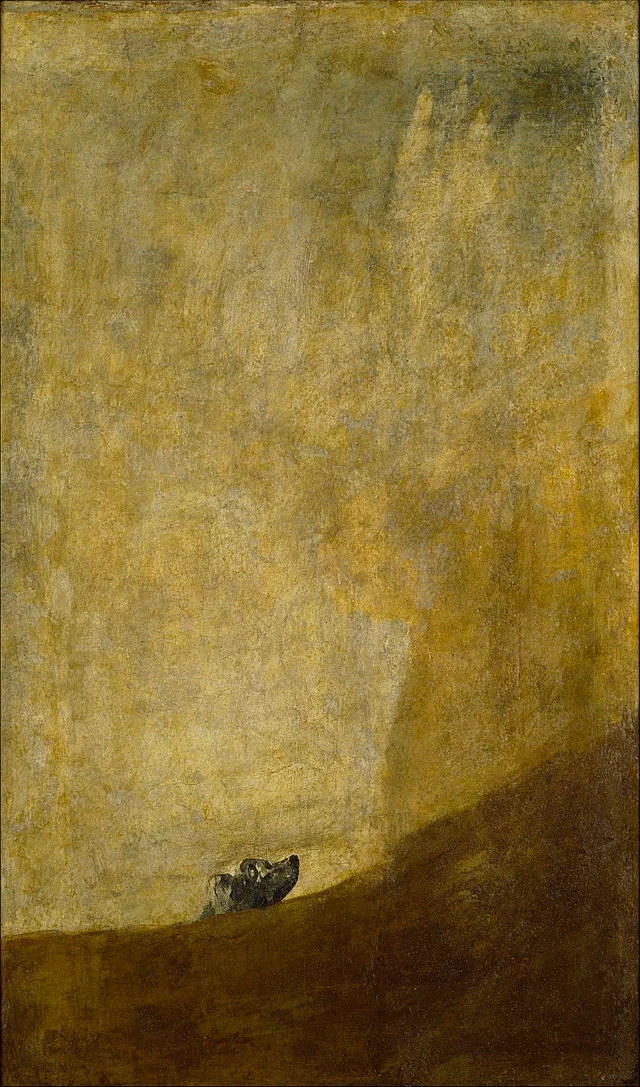

This is a strange painting. What we see is the head of a dog, gazing towards something outside the composition. The dog is largely hidden behind something, and there is a vast, undefined space above it. The painting is composed of earth colours: ochre, brown, and black.
The painting is by Francisco Goya (1746-1828) and was originally painted directly onto one of the walls in his home. Towards the end of his life, Goya became depressed by an illness that made him partly deaf, and he started surrounding himself with darker images—resulting in a sequence of morbid, mostly nightmarish motifs. These mural paintings have become known as the Black Paintings, due to both the amount of black pigments that he used and their sombre subject matter.
Francisco Goya is one of the artists that are presented more thoroughly in our Art and the Human Condition email sequence. Learn more about this service by clicking the button below
The Baron Émile d’Erlanger acquired Goya’s house (known as 'la Quinta del Sordo', or Deaf Man’s House, in English) in 1873 and had the paintings transferred to canvas. The paintings lost a large amount of paint in this process, so it is hard to know exactly how the paintings originally looked. The collection was ultimately donated to the Prado Museum, where it has been on display since 1889.
What does this painting mean, then? Perhaps it is futile to ask such questions in this case. The dog looks at something uphill, as if it were curious about something up there or something that is coming towards it. Or, to be honest, the 'hill' looks like a gigantic horse back to me, with the tiny dog sitting on something behind it. It seems to be a pale moon hidden behind fog at the centre of the top half. The "hill" at the right of the image seems to be dissolving into air, or perhaps there is some kind of shadow spreading. Some art critics have—I understand it—been related to the idea of the inevitability of death, but the image is highly enigmatic.
To me, however, the look on the dog’s face represents hope; I choose to believe that the dog is looking at something above him with some sort of anticipation. The composition is extremely powerful, and the large, empty space makes an impression of solitude. The dog, being a social animal, welcomes a companion, perhaps, or if the image is related to death, it is a welcomed death. Either way, something—in my view—is coming, indicated by the darker area, a shadow that is cast, it seems, in the direction where the dog is looking.
It is a fascinating picture, with pleasant colour tones. It is easy to look at, and its lack of obvious meaning and a consideration of the circumstances under which it was made give opportunity to contemplate the bigger questions in life.