
The Canal
A canal can symbolise different kinds of borders. I think it is easy to see what the canal below divides, but you might have different views on the matter.
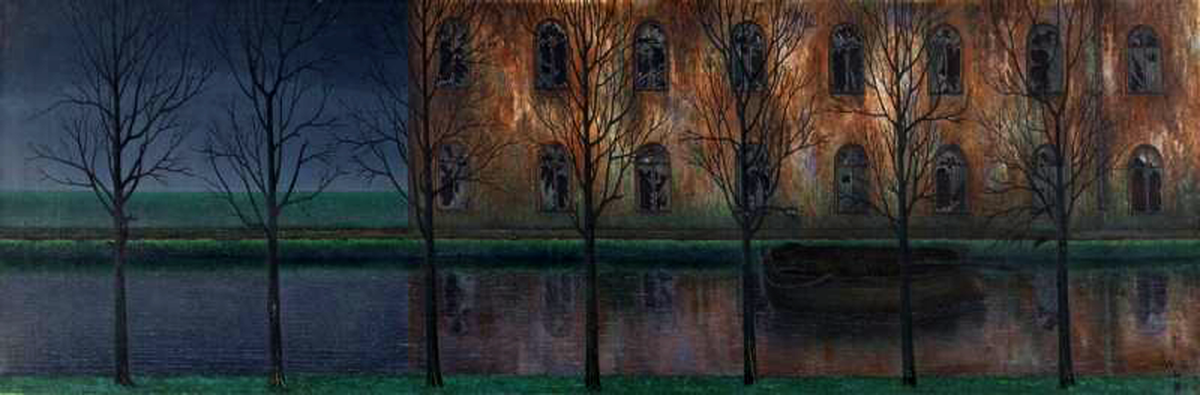
William Degouve de Nuncques (1867-1935) was a Belgian painter connected to the symbolist movement. This painter is a new discovery for me, and I must say his catalogue is populated with quite a few interesting images, though with a spooky feel. He was born in the city of Monthermé, in the French Ardennes, but spent much of his life in Belgium. He subsequently became known for his Symbolist style, which emphasised imagination, dreams, and the mystical aspects of life.
Degouve de Nuncques was a deeply introspective and imaginative artist who often depicted surreal landscapes and dream-like scenes. He was greatly influenced by the work of the French Symbolist painter Odilon Redon, whose use of colour and fantastical imagery inspired de Nuncques throughout his career.
Degouve de Nuncques began his artistic training at the Brussels Academy, where he studied with the renowned Belgian painter Jean-François Portaels. In the early years of his career, de Nuncques was known primarily for his landscapes, which typically depicted quiet, serene scenes of nature. His use of muted tones and misty atmospheres created an otherworldly feeling in his paintings, foreshadowing his later work in the Symbolist style.
One of Degouve de Nuncques’ most famous works is his painting “The Blind House” (1892), which depicts a small cottage in the woods, surrounded by mist and illuminated by a soft, pink light. The painting is a quintessential example of the artist’s Symbolist style, with its dream-like quality and use of colour to convey emotion and mood.
In addition to his landscapes, Degouve de Nuncques also produced numerous portraits and still lives throughout his career. His portraits are often stark and contemplative, with the subjects appearing lost in thought or deep in reverie. His still lives, on the other hand, are characterised by their simplicity and stark beauty.
In 1893, Degouve de Nuncques became a member of the Les XX group, a Belgian artist collective that included such luminaries as James Ensor and Fernand Khnopff. The group was known for its progressive and innovative approach to art, and Degouve de Nuncques’ inclusion was a testament to his growing reputation as an important and influential painter. In 1894, he married fellow artist Juliette Massin, who introduced him to the circle of Symbolist poets, who also had a considerable influence on his style.
Despite his success, Degouve de Nuncques was a deeply private and introverted individual who shied away from the spotlight and rarely gave interviews or public appearances. He spent much of his later life in the small Belgian town of Stavelot, where he continued to paint until his death in 1935.
The painting
The Canal was painted in 1894, and it depicts a quiet, misty canal at night, with a large building and trees following the canal and that are reflected in the still water. All the windows in the building are broken, like they have been smashed out. There appears to be a deserted boat in the middle of the water, and the moon shines in the sky, illuminating the scene with a gentle, ethereal light.
The landscape is dreamlike, and its atmosphere is kind of… well… poetic, in a way. The use of muted tones and subtle contrasts gives the painting a sense of serenity and tranquillity, and still, the hazy, indistinct forms suggest a mystical, otherworldly quality. There seems to be something going on in the painting that is hard to catch. The cropping of the scene makes me feel that there is something on the immediate outside the view that the artist didn’t want us to see.
This is a typical example of paintings where I can lose myself in a hunt for hidden meaning. The first question that pops into my mind when I see paintings like these is “What does it mean?” And then, “What does it really mean?” Of course, over the years I have learnt not to expect too much from these questions; in many instances I am left to myself to create this meaning.
Symbolism As Open-Ended Art
As a historical art movement, Symbolism provided a transition from Romanticism in the early part of the 19th century to modernism in the early part of the 20th century. The Art Story summarises symbolism as this:
As opposed to Impressionism, in which the emphasis was on the reality of the created paint surface itself, Symbolism was both an artistic and a literary movement that suggested ideas through symbols and emphasized the meaning behind the forms, lines, shapes, and colors. The works of some of its proponents exemplify the ending of the tradition of representational art coming from Classical times. Symbolism can also be seen as being at the forefront of modernism, in that it developed new and often abstract means to express psychological truth and the idea that behind the physical world lay a spiritual reality. Symbolists could take the ineffable, such as dreams and visions, and give it form.
Further, Symbolism’s emphasis is on emotions, feelings, ideas, and subjectivity rather than realism. Paintings in this tradition, then, leave much in the hands of the spectator and divide the construction of meaning between the artist and the viewer. I really like this division of labour, where the artist provides the “raw material” for interpretation but keeps many possibilities of meaning open.
And further, I like the idea that behind what is apparently real, beneath what we have become accustomed to seeing and making meaning of, lies another dimension, something hidden from the everyday, but still there, somehow. I’m not a fanatic, though; I can easily see that a spiritual view of the world can lead astray and that absurdity lurkers in the shadows, but, philosophically, the question remains—I think—about what we in fact experience as part of reality. In a previous post, I wrote about the English poet and artist William Blake, who claimed to see and experience a spiritual dimension in the world and visualised this through his work. How do his art and poems make meaning to so many people if people don’t recognise something in them? I’m confident that I’ll never experience such grand spirituality in my earthly life; for me, it is sufficient to think, “What if…" But to me, what-ifs are just as interesting as what-is.
If we take a close look at the painting above, we see that the line of trees is placed on “our” side of the river. On the other side, there is only the deserted building. And in the middle—as mentioned—a boat. So, what if the other side of the water is the land of the dead? What if we have come so close in our lives that we can identify the other side? The boat lies idle in the middle of the water, so it is, perhaps, not yet our turn, so if there is anything we still need to do, we should hurry. It may be time to turn back and do what we need to do in order to cross the water in peace.
I find such doodling to be a kind of private haven; spending time with artistic expressions like the one above actually gives rise to new reflections for me.
What do you make of it?