
Subtle Signs and Silent Hierarchies
This painting by Frédéric Bazille reveals more than an orientalist interior. Beneath its surface lie social hierarchies and a subtle medical observation—details that only emerge when we learn how to look closely.
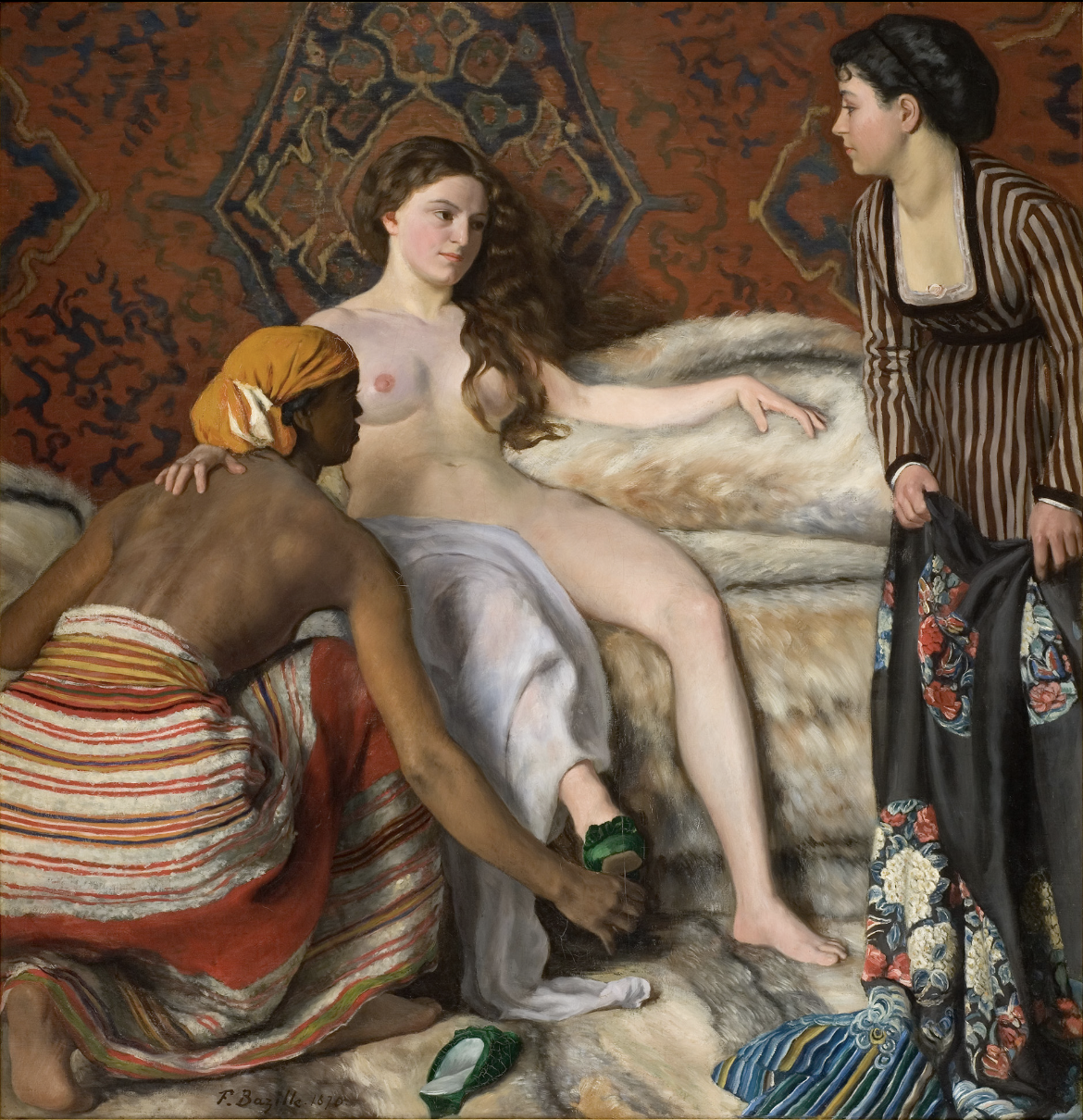
This picture was painted about one hundred years before I was born, in 1969. I often wonder what the audiences made of it when it was first shown. The orientalist atmosphere must have felt exotic at the time.
To me, there are two particularly intriguing aspects to this painting: one cultural and one medical. I will explain these below, but first, a few words about the artist.
The painter
Frédéric Bazille (1841–1870) was a French painter associated with the Impressionist movement that emerged toward the end of the 19th century. He died young, at only 28 years of age, while serving as a soldier in the Franco-Prussian War.
Bazille grew up in a wealthy middle-class family at the family estate in Montpellier, Languedoc-Roussillon, France. Through his father’s connections, he was introduced to art by the collector Alfred Bruyas, and his parents allowed him to attend art lessons, provided that he also studied medicine. Bazille was educated as a medical doctor between 1859 and 1864, but he failed his final exam in 1864 and did not pursue this path any further.
By around 1862, however, Bazille had become acquainted with several renowned painters, including Pierre-Auguste Renoir, Alfred Sisley, Claude Monet, and Édouard Manet, and he grew increasingly drawn to Impressionist painting. After failing his medical exam in 1864, he devoted himself to painting full-time. He attended art classes to deepen his understanding of the craft, which was to become both his passion and profession. Bazille was generous by nature, and because he was financially better off than most of his friends, he shared a studio with Pierre-Auguste Renoir, among others. The painting above was executed during the period when the two shared a studio, in 1869–1870.
Bazille’s work was largely neglected after his death. However, in 2016–17, the exhibition Frédéric Bazille and the Birth of Impressionism, which toured the Musée Fabre, the Musée d’Orsay, and the National Gallery of Art in the United States, revived interest in his work and positioned him as a key figure in the evolution of modern art.
The painting
What we see in the painting above is the interior of a harem. The Orient was not a major source of inspiration for many of the Impressionists (with the notable exception of Renoir), but Bazille travelled widely and was influenced by the cultures he encountered on his journeys.
The painting depicts two attendants serving one woman. One of the attendants is helping her put on her shoes, while the other is preparing a cape for her to wear. The central figure appears somewhat absent-minded, as if her thoughts are elsewhere, while the two other women are clearly focused on the well-being of their mistress. The fur, the tapestry, and the warm colours combine to create a pleasant scene infused with luxury.
The painting was submitted to the Paris Salon but was rejected. Bazille never publicly exhibited it.
Two Intriguing Aspects
Now, let us turn to the two intriguing aspects of this painting, beginning with the cultural.
It is possible to identify three distinct roles in the scene—a clear hierarchy of functions. At the top of this hierarchy is the woman in the centre, who is being served by the other two. She—as mentioned—pays little attention to them; it seems to be her right to have servants attend to trivial matters such as washing her body and dressing her. Judging purely from the visual positioning of the persons in the painting, second in rank is the woman on the right, who is preparing her mistress’s robe. She stands upright but closely observes her mistress, ready to act at the appropriate moment. At the lowest level, it appears, is the woman on the left. She is kneeling in front of her mistress, attending to the lowest part of her body: her feet. It is striking that the central woman holds her hand on the shoulders of the kneeling woman. It almost seems—and this interpretation is, of course, open to question—as if she is preventing her from rising. “Stay down,” she seems to signal, “you are not finished.” Or, in a more sympathetic view, she is trying to help the woman kneeling hold her balance, as the position she is in seems uncomfortable.
If we look beyond the obvious mismatch between the cultural signals in this painting and contemporary standards of equality, it is still possible to reflect on the roles we ourselves occupy in everyday life. Which of these roles do I play? Am I a master, or am I a servant? Or, perhaps more interestingly, in which situations am I on top of the world, and how do I treat others when I am in a position of power?
The second intriguing aspect of the painting is medical in nature. The woman on the right is Lise Tréhot, who at the time was in a romantic relationship with Pierre-Auguste Renoir. She appears in many of Renoir’s paintings, but only in this one by Bazille. Interestingly, one could argue that Bazille the doctor is here informing Bazille the painter. There is a feature of Tréhot in this painting that is scarcely visible in Renoir’s portrayals of her: Bazille appears to have identified that she was affected by goitre. Medically, goitre is a condition in which the thyroid gland becomes enlarged, often caused by autoimmune disease, thyroid nodules or iodine deficiency. It is relatively common and typically appears as a swelling or lump on the neck.
I find it fascinating that this detail is apparent only in Bazille’s painting. To me, it points to an important truth: knowledge shapes perception. We understand the world not only through our senses but also through language and analytical frameworks. Before researching this painting, I did not notice anything unusual in the scene, or, if I did, I might have attributed the deformation on Tréhot’s neck to artistic choice or lighting. Now, after learning that medical professionals have identified this feature in Lise Tréhot, I am able to see it clearly. Knowing what goitre looks like and how it develops enables a trained observer to recognise and depict it accurately. In this sense, the deformation on Tréhot’s neck functions as a sign—one that speaks a language understood only by those literate in medical knowledge. Bazille is, in effect, speaking as one medical doctor to another: Lise Tréhot had goitre.
In my view, this is what knowledge does. It allows us to identify elements that remain invisible to the untrained eye.
References
The information for this post is derived primarily from three sources: the Wikipedia articles on Bazille and La Toilette; the Britannica article on Bazille; and an article by L. Obolonczyk, M. Berendt-Obolonczyk, and K. Sworczak (2019), published in the Journal of Endocrinological Investigation.