
Brace yourself before a painting that—if one is not cautious—may lead your thoughts astray.
Before we go on to contemplate the painting in question, a personal note is in order. Lately, I have been reading Confessions by the French philosopher Jean-Jacques Rousseau. Rousseau is a major figure in the history of philosophy. Even though living and working in the time of the Enlightenment, Rousseau represented a kind of romantic counterbalance to the emerging belief in science and systematic research. In my line of professional work (in the domain of educational science), he is most famous for his novel Emile, which depicts Rousseau’s view of how a child should be raised. I don’t always (or perhaps even most of the time) agree with his views on this subject, but I have really been taken by his honest self-presentation in his Confessions. Here, he seems to be brutally honest in writing about his victories and failures, his virtues and his vices. After some hours reading into his work, I’m starting to feel that I’m beginning to know how the author has been thinking, what his rationale was, and what was driving him. This has made me sympathetic towards his perspectives, and as he presents his choices in different parts of life, his reasoning starts to make sense. In fact, I’m starting to see the benefit of approaching one self in this brave, honest way. In a quest for understanding my own life and circumstances better, I have been inspired by Rousseau to be more challenging and daring in my artistic preferences.
I can see the outline of several fields where Rousseau’s writing can be of service to me, and I suspect I will come back to Rousseau’s momentous work in later posts. However, a more immediate effect of this inspiration is to present here a painting I did not know if I dared show. Being of a romantic disposition, I read a lot into facial expressions, scenes, and gestures that might not "objectively” be there, but still, they are there in my construction of them. The painting here is one such scene that I… well, to be honest, find some kind of solace in. Given, of course, that I detach the painting from the actual circumstances of production—i.e., the real identity and personality of the model—and am free to put my own layers of meaning onto it.
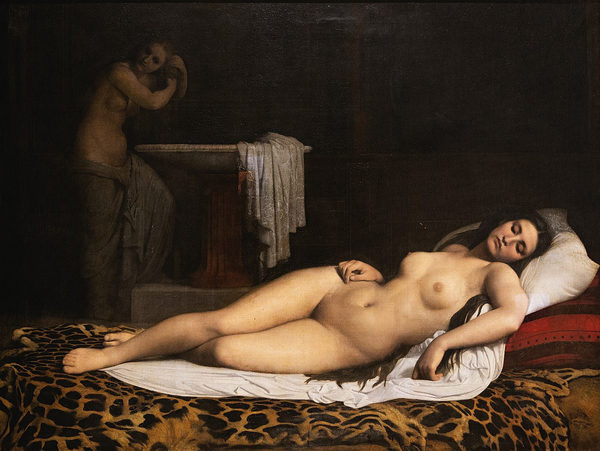
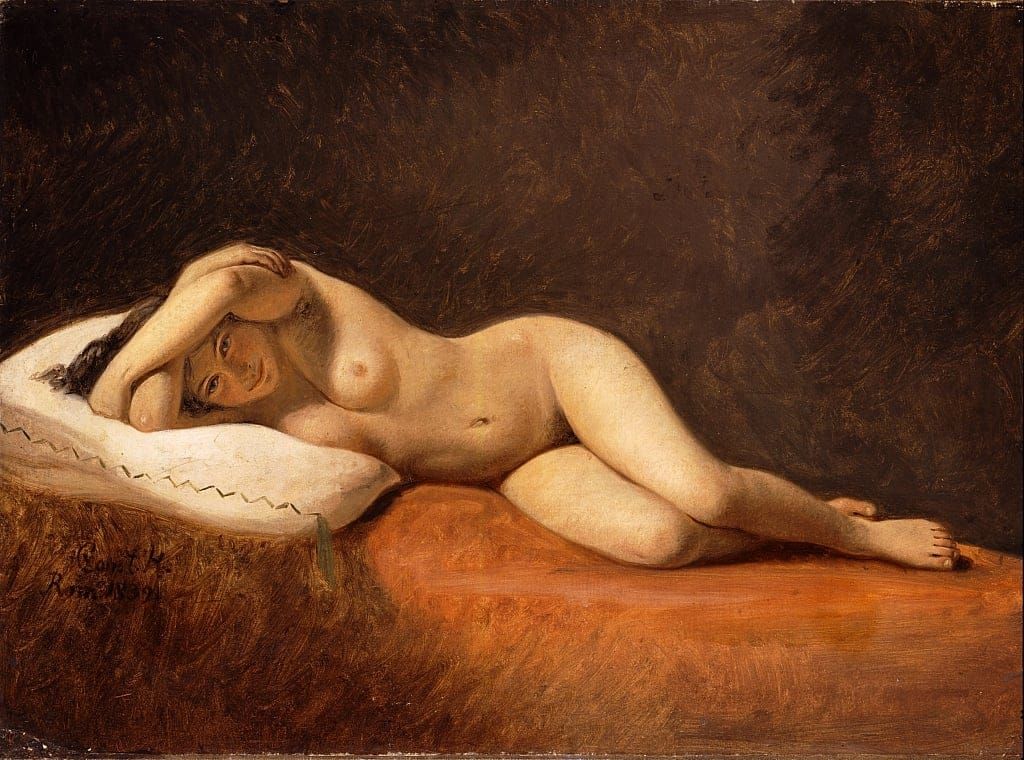
Constantine Hansen was presented here at Naive Notions in an earlier post. As mentioned there, he was a student of Danish artist Christoffer Wilhelm Eckersberg (1783–1853) and followed to some extent in his master's footsteps. However, where Eckersberg applied an academic style to his nude paintings, Hansen developed toward a more outspoken expression. Traditionally in art, the nude object was supposed to be modest and not too imposing. In the painting above, however, the model does not look away when painted nude but gazes at the viewer and, by this, invites a conversation (in the broadest understanding of the term). She does not seem particularly embarrassed; on the contrary, she expresses interest in getting in touch. The painting was made when Hansen resided in Rome, and perhaps the southern climate and environment affected his view on the possible modes of expression.
Around the web I have seen this painting be described as a celebration of the woman’s anatomy, and after thinking about it, I find this a fitting description. Of course, many paintings "celebrate" the female body, but Hansen does this without any reference to the academic art tradition and without complying with the prevailing stylistic codes at the time. The colours are warm and inviting, and the woman is lying (more or less) comfortably on a bed, relaxing in a way that makes us admire her.
Erotic, but more
Google Arts & Culture calls the painting "unashamedly erotic", and to some extent I agree. When trying to describe this painting, «erotic» is perhaps one of the words that come to mind. However, if we acknowledge the view that the painting displays a celebration of the female body (as Google Arts & Culture also promotes), we arrive at a dilemma. If we view a celebration of a woman as foremost erotic, we might forget that a woman is many other things as well. She is a bearer of children, an intellectual, a life companion, half the world's population. Still, I find traces of these elements, too, in the painting by Hansen. The "open" expression on her face, her smile, and her joyful posture all add to the celebration. Even though 'erotic' is one of the terms that absolutely fits the painting, 'care', 'playfulness', and 'compassion' also appear in my mind when I look at it. This is a portrait of the kind of women that walk unnoticed among us but, when acquainted, reveal a universe of amiability, kindness, and contentment. There is something in the scene, I think, that points far beyond the mere erotic. This is a whole woman, a woman that many would like to get acquainted with.
You may think I am stretching my interpretation a bit too far on this painting. And if I were an educated art critic with an aim to inform the public of what was universally acknowledged about the painting, I would certainly agree. But—again inspired by Rousseau—my focus lies not so much on the art itself but more on the relationship between the artistic action on one hand and my personal reaction on the other. Subtle feelings, feelings of kindness, and feelings of understated emotions emerging slowly, like when you first meet someone both intellectually interesting and physically charming, are what grow in me when spending some time with the painting.
You, however, may find something completely different in this image.