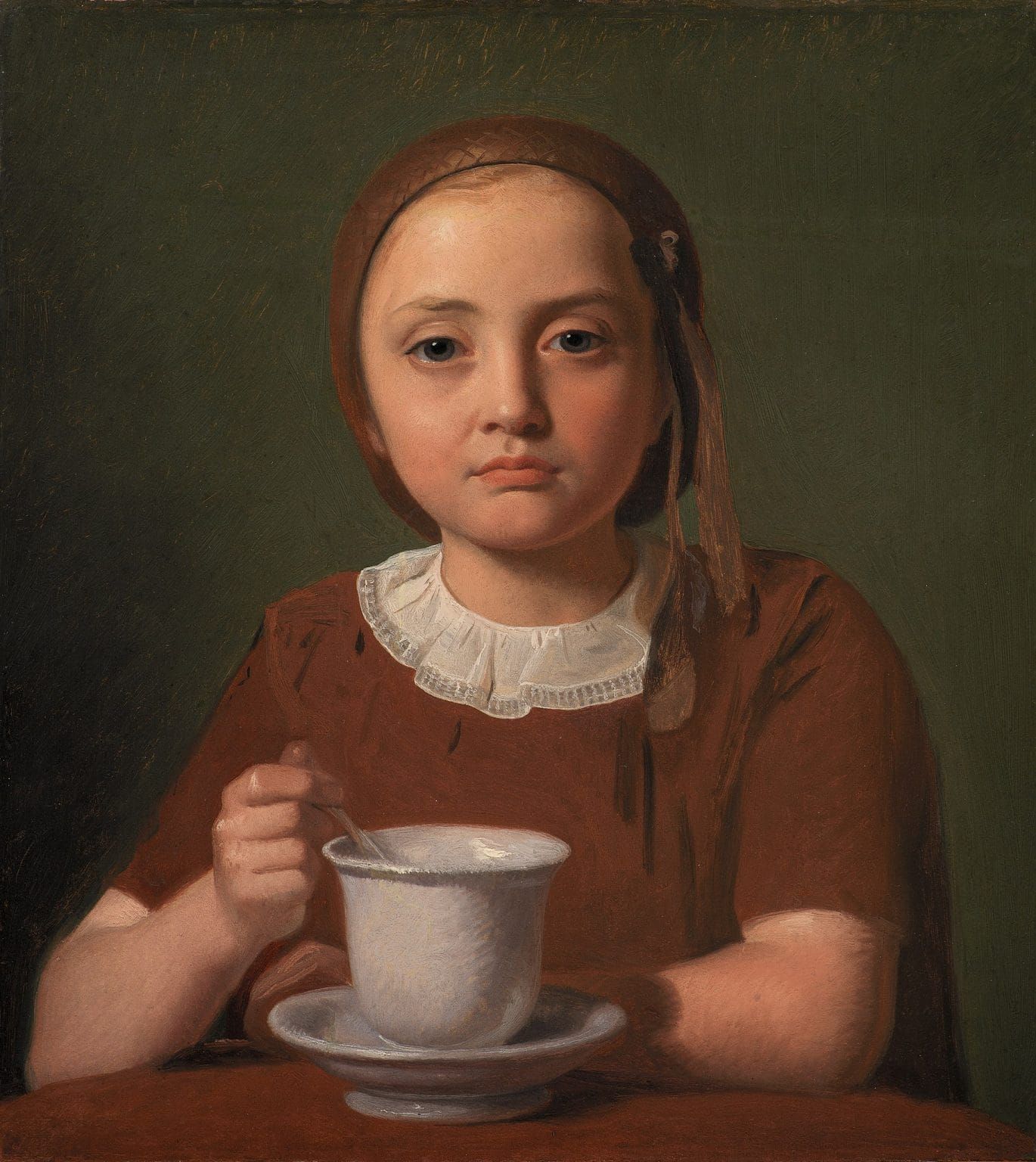

Some paintings just draw you in. The first time I noticed this painting, it was in the corner of my eye. It was a poster in a shop, with many others hanging on the wall around it. But still, this one made me turn my head, as if someone were watching me. I looked at her, and I found myself believing for a moment that she actually was looking at me too. It was as if she had just raised her head from looking down into the cup (I imagine it contains hot chocolate), suddenly disturbed by something or someone. And there we were, the girl and I, looking at each other.
The painter
Carl Christian Constantin Hansen (1804-1880) was a Danish painter associated with the Golden Age of Danish painting. He was born in Rome, but the family relocated to Vienna soon after his birth. Here he was baptised, with no other than Constanze Mozart—the widow of Wolfgang Amadeus Mozart—as his godmother. The story had it that Constantin’s parents had met each other in the home of Constanze Mozart and her second husband, the Danish diplomat Georg Nikolaus Nissen, at their residence in Vienna. In fact, Constantin was named after Constanze as a tribute to her. However, the family moved to Denmark soon after, and little Constantine was raised in Copenhagen.
After spending some time at the art academy in Copenhagen, Constantine started to study painting from the age of 21. He began his training under Christoffer Wilhelm Eckersberg, another prominent figure in the Danish Golden Age. His education lasted until about 1833, when he started travelling to see the world. During his extensive journeys in Italy, among other places, he made studies of Roman antiquities and architecture that reflected Eckersberg’s style.
During his journeys, he met several fellow countrymen, including Jørgen Roed and Christen Købke, and travelled with them. After eight years in Italy, however, he returned to Denmark, and in 1846 he married Magdalena Barbara Købke. They had thirteen children together, although four of them did not make it past infancy.
Both Magdalena and Christen referred to above bear the name 'Købke', but how they were related is difficult to establish. None of the available Danish sources make any references to their relationship. Still, the Købke family was big, and it is possible that Magdalena and Christen were third or fourth cousins.
In his portraits, Hansen did not strive for an absolutely realistic rendering of his models. This too, perhaps, was something he had picked up from his mentor Eckersberg, as Eckersberg argued in his teaching that the students should paint a detailed and accurate, but still idealised, version of the reality they saw. Constantine’s take on this was that he tried to create a balance between the beautiful and the natural. In his essay The “Beautiful Arts” Unity (De “Skjønne Kunsters” Enhed in Danish), he argues about the relationship between naturalism and idealism: “The one seeks truth at the expense of beauty, the other seeks beauty at the expense of truth, but in every piece of art these two must be merged” (my translation).
The painting
So, back to the painting. The girl in the portrait is Elise Vilhelmine Købke, sister of Constantin’s wife Magdalena. Elise, then, is the artist’s sister-in-law. In a letter to Elise’s brother, Lieutenant Peter Købke, dated October 11, 1850, Constantin Hansen writes: ”In this time (…) I paint, among other things, a portrait of little, endearing Elise." Elise was born in 1839, making her 10 or 11 years old at the time of painting. Sadly, she died young in 1857, only 17 years old.
The painting is captivating, with Elise’s intense gaze toward whoever watches her. When looking at her for a while, however, her eyes start to assume this soft, dreamy look, as if she is not staring right at you after all but absentmindedly just rests her eyes on the viewer. I really wonder what she could have been thinking about, what really was on her mind at the moment of painting. Of course, as Constantin Hansen was eager to approximate “truth” and “beauty”, we cannot say exactly how she looked. But whatever the “objective” fact might be, the mood in the painting appears enigmatic, and I catch myself thinking that any moment now, she will return to her business, moving her eyes toward the cup again, and continue to stir. It is as if this particular moment, this instance in 1850, with Elise across the table, is frozen in time. The painting makes me reflect on the fleeting qualities of life (not least because Elise did not make it into adulthood) and how important it is to appreciate moments just like this.
Notes & References
Sources used for information and inspiration: Artvee, Document, and The Danish Wikipedia article on Constantin Hansen.