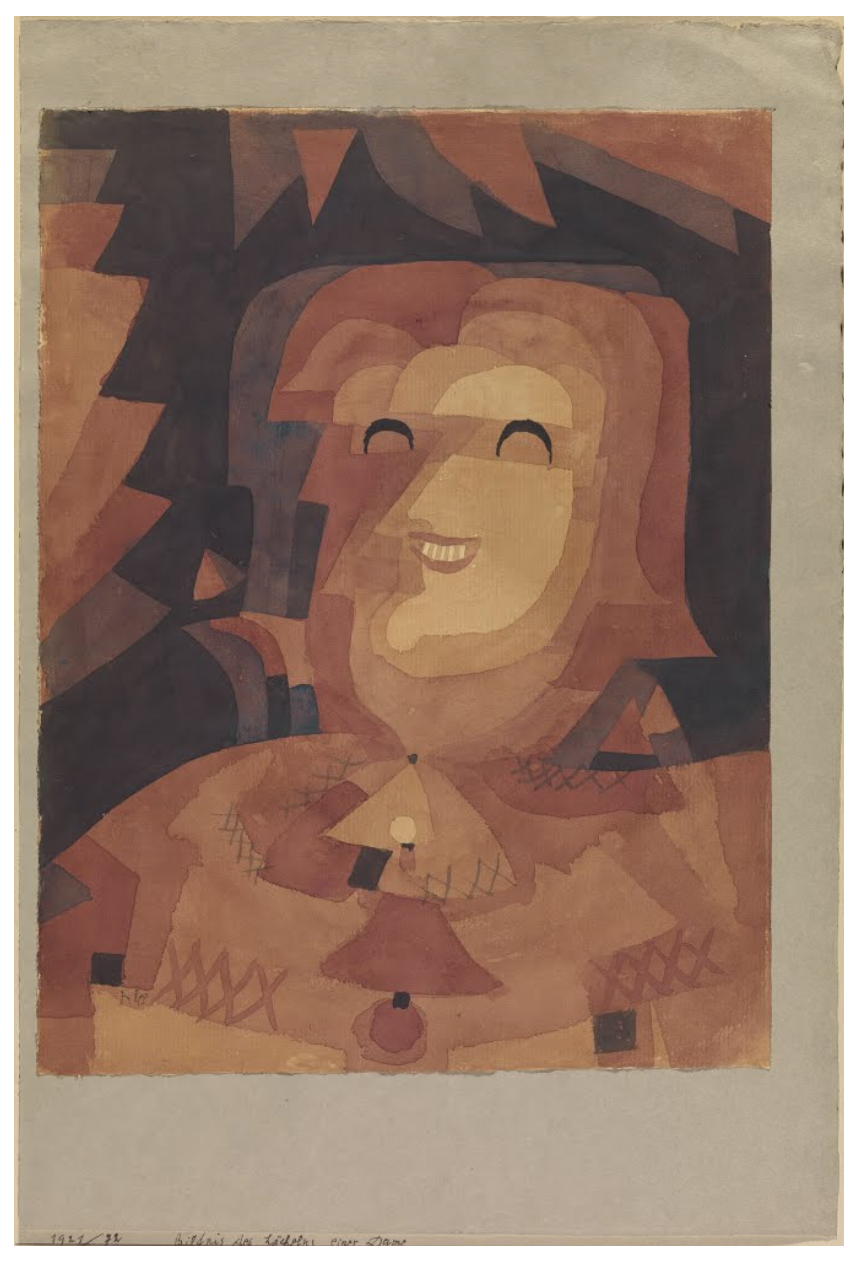

This is one of the most feel-good pictures I know! Just look at her, sitting there with her warm giggling laughter, closing her eyes in amusement, remembering something funny, perhaps. My spirit lifts every time I look at it, and as work has been a bit too much lately, leaving me stressed up with all the deadlines, I let this picture remind me that there are simpler and more authentic pleasures in life.
Paul Klee (1879-1940) was a Swiss-born German artist. Through his lectures on form and design theory with his colleague Vassily Kandinsky at the Bauhaus School of Art, also published in English as the Paul Klee Notebooks, he influenced modern art enormously.
His inspiration came, among others, from Leonardo da Vinci, Michelangelo, and Botticelli, but also from artists like Francisco Goya and William Blake. He studied these masters in Italy at the outset of the 20th century, and with this background, he formulated his artistic foundation in words. He would aim to present himself as an intent into the world and “express something quite modest that would not offer the pencil any technical difficulties”. It is, then, no wonder why his works have a somewhat childish flavour. As Michael Duchamp noted in 1949:
The first reaction in front of a Klee painting is the very pleasant discovery, what every one of us could or could have done, to try drawing like in our childhood. Most of his compositions show at the first glance a plain, naive expression, found in children's drawings.
But of course, as Duchamp also acknowledged, there is a lot more going on in his art than that.
He was highly celebrated, and his joyful, creative and child-inspired style made him able to think outside the conventional three-dimensional form. It is always the object's fundamental shape that is Klee’s point of departure, but on this basis he develops his objects into the most imaginary visions.
Free association played an important role in his art, and this is something, I think, we restrain too much in our efficient and scientific society. Our everyday routines shape us into linear beings, but Paul Klee and his art, perhaps, may lift us out of this and make us enjoy a more unrestrained life.
The hope that this is possible constitutes a refuge in stressful and turbulent times.