

Edward Hopper (1882-1967) has started to fascinate me. Even at an early age, Hopper was convinced he would be an artist, and I find that kind of determination impressive. Even if he at some point considered a career in marine architecture, his line of commitment came to follow another path.
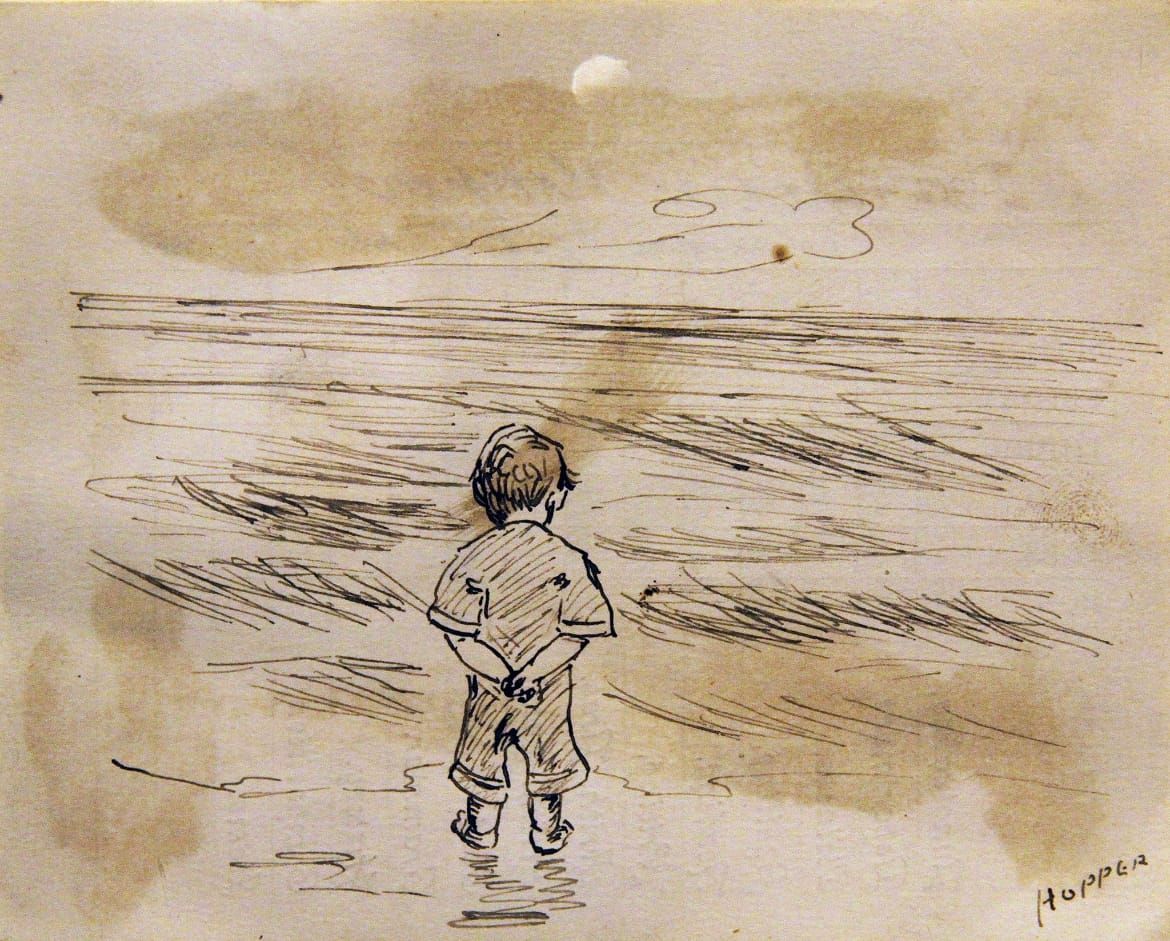
The image above was drawn by Hopper on the back of a report card at the age of nine! The boy in the image is standing close to the water, barefoot, with his head slightly leant forward and with his hands clasped on his back. It seems he is thinking about something, like only children can do, losing himself in the sight of the waves and the sound of the ocean. I really wonder what a 9-year-old, future world-famous artist made of a scene like this at the end of the 19th century.
Even if I feel I can hear the waves when I look at the drawing, the stillness and the contemplative emotion that the boy conveys get to me. The boy seems precocious with his posture, not particularly joyful, but somewhat burdened with his thoughts. I can’t help but feel there is an element of sadness in the picture, a sadness evoked—I think—by the fact that this is a drawing by a child. Of course, Hopper was an artistic prodigy and practised hard even from an early age, as his worn child’s paint box testifies to, but still, he was a child. I’m not going to attempt a psychological analysis of the drawing, but as I find Hopper’s more mature paintings a bit desolate, this “mode” is perhaps something that he kept with him from his childhood. Many of his paintings in later life convey a certain loneliness, a feeling of solitude, an emptiness of sorts, as if there is nothing behind the varnish. I get a feeling of «what you see is what you get», but nothing more.
I might be violating the canonised model of interpretation here, but to me, Hopper might be seen as a postmodern artist—in the philosophical sense of the word; there is nothing beyond the surface. Like the famous analogy with the onion, searching for any more profound meaning in life is futile: You can peel all the layers of an onion, getting closer to the core with every layer removed, but when you get to the centre, there is nothing there. The centre was no different from the layers peeled off; with the last layer removed, there is nothing left. The onion—and thus life, seen through this analogy—exists only as different kinds of surfaces, without a substance or something “deeper” in the middle.
Hopper has become known for his quiet, atmospheric scenes of modern American life, and this “low-key emotion” in his work gains a new depth—I think—when seen in the light of this early drawing. I have not found any information about what grades were on the other side of this report card, but I guess, whatever the results from his schooling effort, he must have found solitude in his skills at drawing.