
Les Grandes Baigneuses
August-Pierre Renoir is one of those painters that stands like magnificent examples of that great art is all about. Still, Renoir had doubts about how to best express himself, suggesting to us—the ordinary people—that even the masters don’t see things as clearly as posterity seems to suggest.
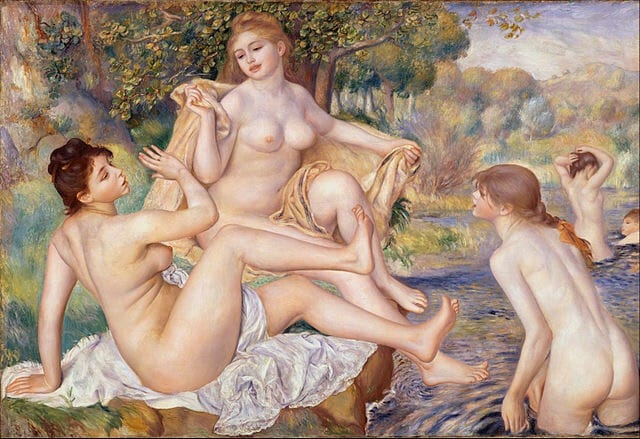
There are many ways to describe and be fond of this painting. Even though the painting has been seen as the foundation for a crisis in the art form it is part of, the painting can just as well represent the benefit of breaking the rules. I will explain why, but to do so we need to say something about the artist.
Pierre-August Renoir
Pierre-Auguste Renoir was born on the 25th of February 1841 in Limoges, France. Renoir started painting when he was 13, as an apprentice in the shop of a porcelain painter. He showed himself to be rather good at this, and he was soon given assignments of decorating hand fans and other eye-catching objects for women. In 1862, however, he started to study art under Charles Gleyre in Paris, and through his studies, Renoir became acquainted with new people, most notably the artists Alfred Sisley, Frédéric Bazille and Claude Monet. These were connections that would show themselves to last, and together with these men, Renoir became a participant in establishing the—now famous—artistic direction called Impressionism. As such, the first Impressionistic exhibition was executed in 1874, and eight such exhibitions were conducted until the last one in 1886. I have written about the origin of this line of painting in a previous post here at Naive Notions, and I think the story about its genesis is quite amusing.
Even though Renoir himself had little money, and occasionally not even enough to buy paint, he managed in 1881 to save up the amount necessary for going on a trip. On this journey, he visited Algeria to study Eugène Delacroix and then Spain to view the works of Diego Velásquez. Further, he travelled to Italy for the paintings of Titan in Florence and Raphael in Rome. Interestingly, Renoir is studying these classical painters just as Impressionism is starting to gain ground (six impressionistic exhibitions had at the time already been executed), suggesting, perhaps, that Renoir was not entirely comfortable with the impressionistic expressions. In the summer of 1883, he travelled to the island of Guernsey, in the English Channel. The island holds a variety of different landscapes, with bays, beaches, forests and mountains, and Renoir gained inspiration to complete no less than 15 works on the island. A majority of these paintings contain a view of Moulin Huet, a bay in the area of Saint Martin.
Les Grandes Baigneuses
And here we return to the painting above. The impressionist movement is characterised by objects or scenes painted in a hasty manner, with few clear lines, and it gives, appropriately, only an impression of what is going on. It is an attempt to capture the moment, to give the viewer a «fleeting glimpse» of the chosen scene. Many of the paintings by both Monet and Renoir, especially in the early years, bear witness to this. It is also for this kind of work that Renoir is most renowned.
But then, this painting, Les Grandes Baigneuses, or The Big Bathers, came along. The painting was started in 1884 and finished in 1887. On his journey in 1881, Renoir had studied the great classical works by Raphael, among others, and this had convinced Renoir that he was on a wrong path artistically. From the 1880s and onwards, Renoir started to work in a more detailed way, with a desire to return to the classic expression. When Renoir returned from Guernsey to Montmartre in Paris, he engaged a woman, Suzanne Valadon, as a model. She is clearly visible in the painting Dance at Bougival from 1883, painted in an impressionistic style, but is also the model for one of the women in the painting above, in a more classical style.
Breaking the Rules
What is liberating about the painting above, inspiring even, is the manner in which Renoir decided to break with Impressionism. If we look at the image, it is a mix between two styles. The background, with the trees and the grass, is painted in more of an impressionistic manner, while the women in the foreground are conveyed in much more detail. Their expression resembles that of the Classical Greek sculptures, with the colour palette and the focus on detail. Instead of being characterised by hastiness, this scene bears resemblance to more traditional studies of classical beauty but is presented through women from Paris in the 1880s. The Impressionist movement was engaged mainly with scenes from real and lived life, as it was experienced in the present. Some interpretations of the image above suggest that Renoir, in a way here, was returning to classical art by painting a scene that was not imaginable at the time. Women bathing nude together in a public park was almost as unthinkable then as it is now. But still, Renoir proposes that this is possible inside the domain of art by combining different kinds of techniques. By bringing elements from the past and placing them into the present, Renoir creates, in some sense, an opportunity, a way of referring and making connections between different domains, that brings us something new.
Because Renoir, as one of the founders of the impressionistic tradition, actually broke with the movement and returned to more classical expressions, the painting is part of what has been called «the crisis in Impressionism». What would the audience think of this kind of artistic expression, the critics of the painting seem to have communicated, if the founders themselves were abandoning it? The time spent in executing Les Grandes Baigneuses also bears witness to the fundamental change that the painting represents. While spending years on this painting, his earlier works were produced significantly quicker. The portrait Renoir painted of composer Richard Wagner when he met him in 1882 was allegedly finished in 35 minutes!
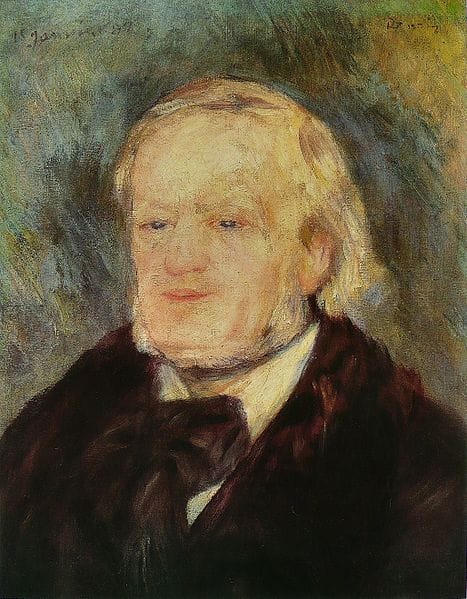
The portrait of Wagner is a truly impressionistic piece of art, caught at the moment, with light, fleeting brushstrokes. On the other hand, we do not only get impressions of the women in Les Grandes Baigneuses; we get a detailed and meticulous representation.
Closing Remarks
In one sense, the women sitting by the water resemble antique sculptors, with their pale, marble-like skin, but as these women obviously wear makeup—both eyeliner and rouge are visible—it is as if they are taken out of Ancient Greece to tell something to Paris in the 1880s. They have travelled through time and entered a new society to remind us, perhaps, of the Ancient Greek values. To remind the viewers of simpler times, more sensual times, freer times. And that art—and life—can be a playful endeavour, if we let it.
Notes & References
I am permitting myself a couple of notes at the end of this post. One is concerned about the island Renoir visited in the summer of 1883, the other is of a more academic kind.
The Island of Guernsey
It is not often that I have come across references to this little island of Guernsey, but there is an absolutely marvellous film set on the island, with the name The Guernsey Literary and Potato Peel Pie Society. The film is about literature and is not concerned about Renoir at all, but it is still very much worth seeing. If you are in the mood for romance, that is. Read more about the film on IMDB.
The Master's Freedom
And then to the more academic note. Inside my own professional domain, epistemology and educational science, I employ this painting as a symbol of what may happen in skill acquisition. There is much to be criticised in the link I am suggesting here, but still, this is a connection that comes to my mind when looking at the painting.
In the 1980s, the two American psychologists brothers Hubart and Stuart Dreyfus developed a five-stage model of skill acquisition, that—with some modifications—became widely adopted. The model explains the five stages from novice, through advanced beginner, competent, proficient, up to the level of expert. At the top level, the professional conduct is intuitive, with all the relevant rules internalised. An expert does not need to reflect upon what to do in various situations. An expert driver, for instance, feels in the body how fast the car is moving, and knows intuitively how to perform in such situations, and how to make the right manoeuvres under different circumstances.
However, some years later, a new level of competence was identified, called mastery. This is where the experts start to break the rules, in order to accomplish the task at hand in new and creative ways. As Rousse & Dreyfus (2021:33) says:
"(M)asters are capable of advancing the boundaries of what counts as sensible or excellent in their domain and, in the process, they sometimes produce lasting transformations of how things are done and performances are evaluated."
This, I imagine, at least in some sense, is what Renoir is doing in Les Grands Baigneuses. Renoir knew all the defining features of Impressionism (after all, he was one of its founders—and yes, the Impressionistic movement was well established by the time Renoir started on the painting in question), but he also had skills in more traditional styles of painting. At some point, he started to look beyond the established set of norms, started to cross borders and created something different. This is not exclusive to Renoir, of course; transcending boundaries might be what happens in every truly creative advancement, but the process is especially evident in Les Grandes Baigneuses.
To me, then, looking at Impressionism from the outside—and over a century later—the painting does not seem to represent a crisis as much as it constitutes development and inspiration to look at artistic expressions anew.