
Café Concert
It is interesting how motives of painting and photography sometimes blend, and gives rise to seeing both mediums in different ways.
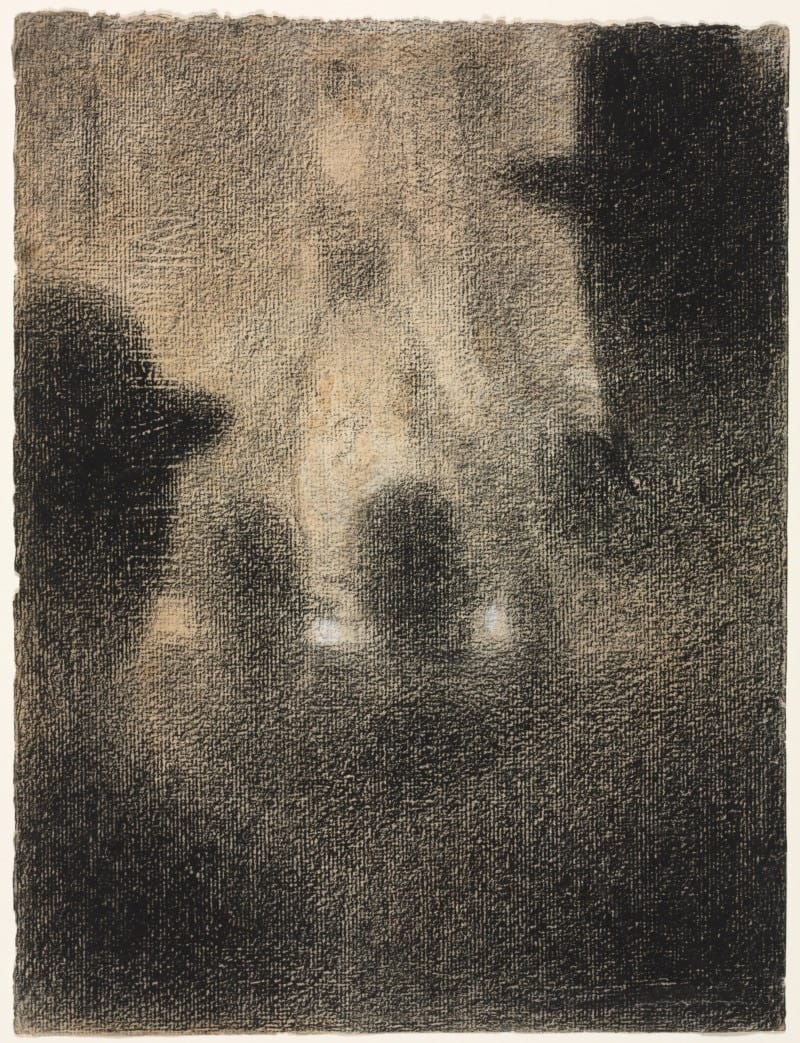
Georges Seurat (1859-1891) was an artist who had just a few productive years, but still, his work is remembered and recognised even today.
As strange as it may sound to art connoisseurs, Seurat is a rather new acquaintance for me. From what I have read, though, he was an artist inspired by Impressionism but moulded the impressionistic ideas and contributed in his own way to a development in artistic styles. He developed a technique that has become known as pointillism, a method in which the image emerges by placing dots of paint on the canvas. This new approach made him one of the most important artists in the post-impressionistic movement.
A Snapshot of a Social Event
The painting I have chosen for this post is strange, I think. It was executed in 1887-88 and depicts an audience at a concert, as seen from behind. From where Seurat is placing the viewer in the painting, peeking up on stage from below, we’re not as tall as many of the others in the audience, as everyone seems to be standing. I get a distinct cramped feeling that the painter's view might soon be hindered by someone in front of him moving. For me personally, at 182 cm, I am at average height, I think, but this feeling is something that I have experienced. What happens when I find myself in such a situation is that I start to worry about my prospects of seeing the whole show. I tend to worry more about my view being hindered than I actually enjoy what I see. It is not a good feeling.
It is curious that everyone in the audience seems to be men, and with hats as well, and it makes me wonder what kind of establishment this is and what, in fact, is happening on that stage. However, I chose to believe what the title of the painting is saying, that this is an ordinary concert, albeit perhaps by a female singer with a special appeal to male listeners.
The technique that Seurat has employed here makes the painting resemble a photograph captured on very grainy film. There are no clear contours; it is all very hazy, making everything in the picture obscure. The perspective, as well, reminds me of a photo—like the person watching has captured a snapshot from where he’s standing. Why did Seurat make such a picture? What would he get out of this?
Perhaps it is better understood if seen in context. As it happens, Seurat made a whole series of concert pictures, and all the pictures in the series are produced with the same technique, making them equally blurry and “atmospheric”.
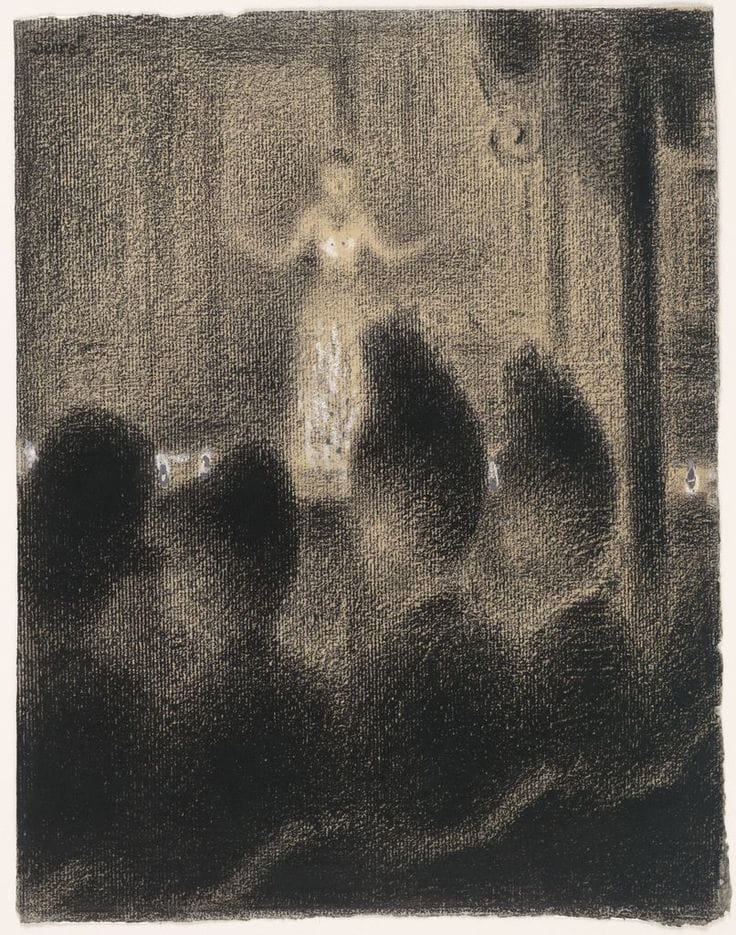
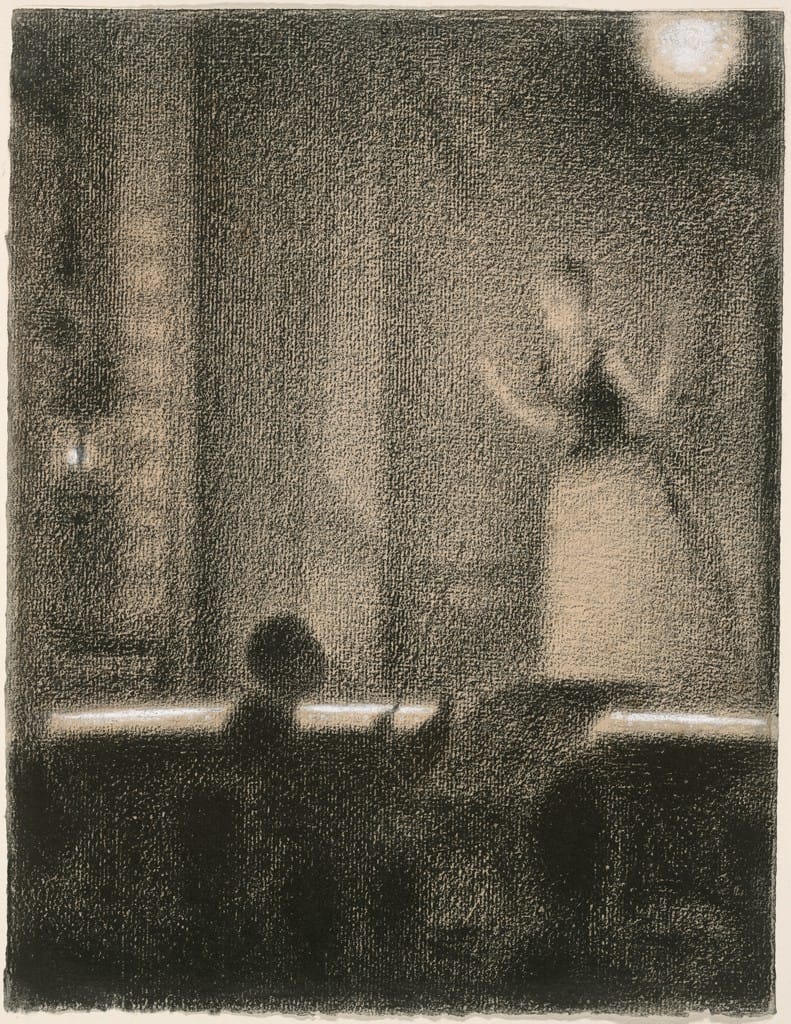
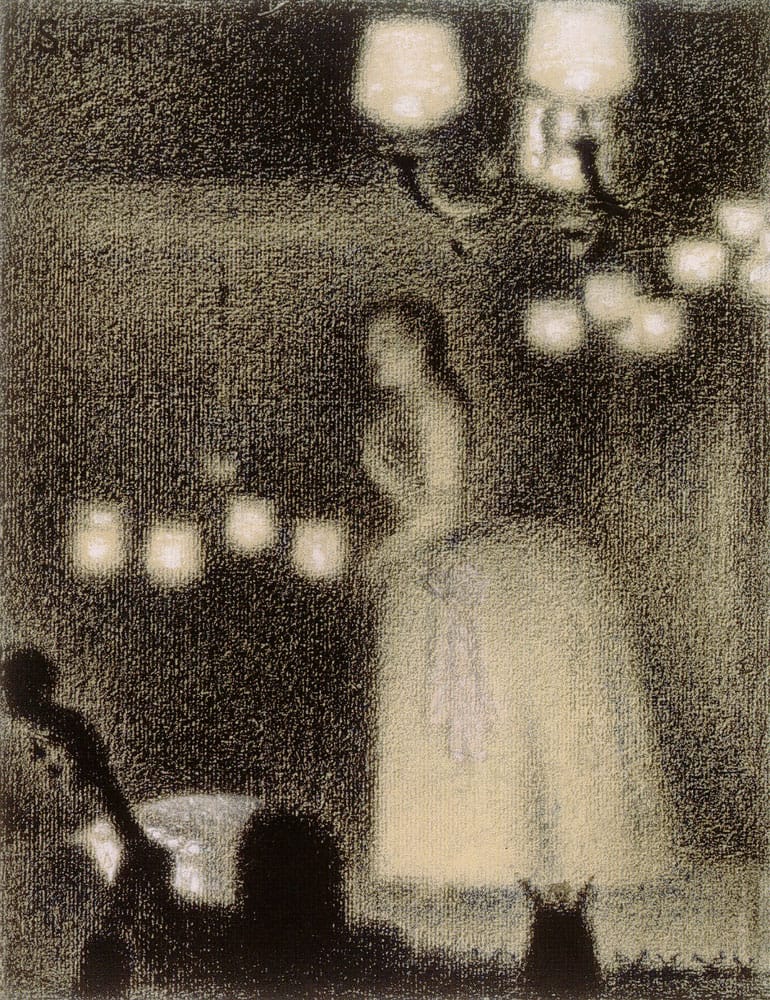
Georges Seurat, Café-concert series, 1887-1888
Through this series, Seurat provided different perspectives on the concert experience, as if different people in the audience had reported their views from where they were placed. And—I think—even if the paintings resemble photographs, it actually makes quite a difference that they are not photographs. If the scenes had been photographs, it would have implied that the scenes were real. To take a photograph, there must be something to take a photograph of, signifying that the scene depicted would need to have taken place in reality at a particular time.
However, as these are not photographs but paintings, the blurry effect becomes, or suits, the scenes differently. Seurat's particular scenes may never have occurred; the images are generalised depictions of concert activities. Construed in this way, the blurriness obscures something that is not there; the scene does not exist outside the painting, making these hazy images everything we have to testify to what is going on. I find that a fascinating feature of the images—and constructed images in general. The images resemble a shortsighted person looking without glasses, but if he could put his glasses on, it would not have made the scene any clearer. The information we have about the scene is both there and not there at the same time. Intriguing, I think.
In my view, this feature—that the message is both reviled and obscured to us—is due to the fact that the painting resembles photographs. In paintings of earlier times, the scene was often more tidy; it had been cleared of elements that were disturbing the "harmony" in the scene. Artistic beauty was not the same as natural beauty; what was perceived as beautiful when out in the woods was not perceived as beautiful when caught on canvas.
This is the same thing that occurs when we, before a magnificent view, try to capture the scene on photos. What we feel in the actual presence of the view is not transported to the still image; too many elements that generate our experience are missing, like smell, sound, and the overall knowledge or feeling of actually being present at this site. It is not such experiences that make the greatest photos. It may serve as a reminder of our experiences, of course, but it rarely becomes art.
In the paintings presented here, however, Seurat has chosen not to make any adjustments; it seems he has only captured what was in front of him, with all its elements. And the thing is, as photographs typically give us a focused picture of the scene (at least something in the scene should be in focus in order for it to give any meaning), the cross between a painting, the snapshot-like elements in the scene, and the hazy feel make me a little disoriented. What is this thing? Is it a painting that wants to be a photograph? Is the artist mocking the—at the time—relatively recent invention of photography by taking its format and obscuring its motive?
The Freedom to See Differently
Of course, it is hard to know whether any of this could have been considerations at the end of the 1880s, or whether, in fact, our knowledge of photography today, as an integrated part of society, is necessary to compare the two mediums. Still, this is what makes art fascinating, I think. We are not stuck with the artist's own view on his work or the contemporary frames of interpretations. When new times arrive and new contexts arise, new meaning and new perspectives can be gained on already existing material.