
Christoffer Wilhelm Eckersberg (1783-1853) was a Danish painter, working in the academic art tradition. He is known to have contributed to the foundation of the golden age of Danish painting and laid the groundwork for the Copenhagen school of painting in Denmark. As a professor at the Royal Danish Art Academy, Eckersberg executed great influence with his teachings about perspective, and he proposed to his students to paint a detailed and accurate, but still idealised, version of the reality they saw.
Eckersberg practised as a historical painter, which was, until the mid-19th century, the most prestigious of the artistic genres. In addition, he was known as a portraitist by his contemporaries. Despite, however, his commissions by the bourgeoisie and royalty, he had no large audience when it came to portraits, and he was often paid less than many of his students.
In his formative years, Eckersberg studied with several artists in Denmark, but in 1810 he left Copenhagen and travelled via Germany to Paris. In 1811 and 1812 he studied under Jacques-Louis David, and here he learnt better to depict the human body, and he followed his master's advice to seek inspiration from nature and antiquity in his paintings.
Jacques-Louis David is one of the artists that are represented in our Art and the Human Condition email sequence. Learn more about this service by clicking the button below
After two years, he travelled further, via Florence to Rome, and he studied in Italy from 1813 to 1816. Here, he advanced his abilities as a history painter and painted small pictures of scenes in the local scenery. But more than this, he was out looking at the Roman architecture, making sketches for paintings. In these works, he applied the skills in perspective that he had gained in Paris, and he took great pain in making every detail in his sketches as accurate as possible. When Eckersberg subsequently went back to Denmark and moved into Charlottenburg as a professor at the royal art academy, all these prospects and sketches were hung in one room and used in his teachings.
However, when in Rome, Eckersberg developed to perfection his skills in using a model in his artwork. And here, we enter the realm of the painting of this post.
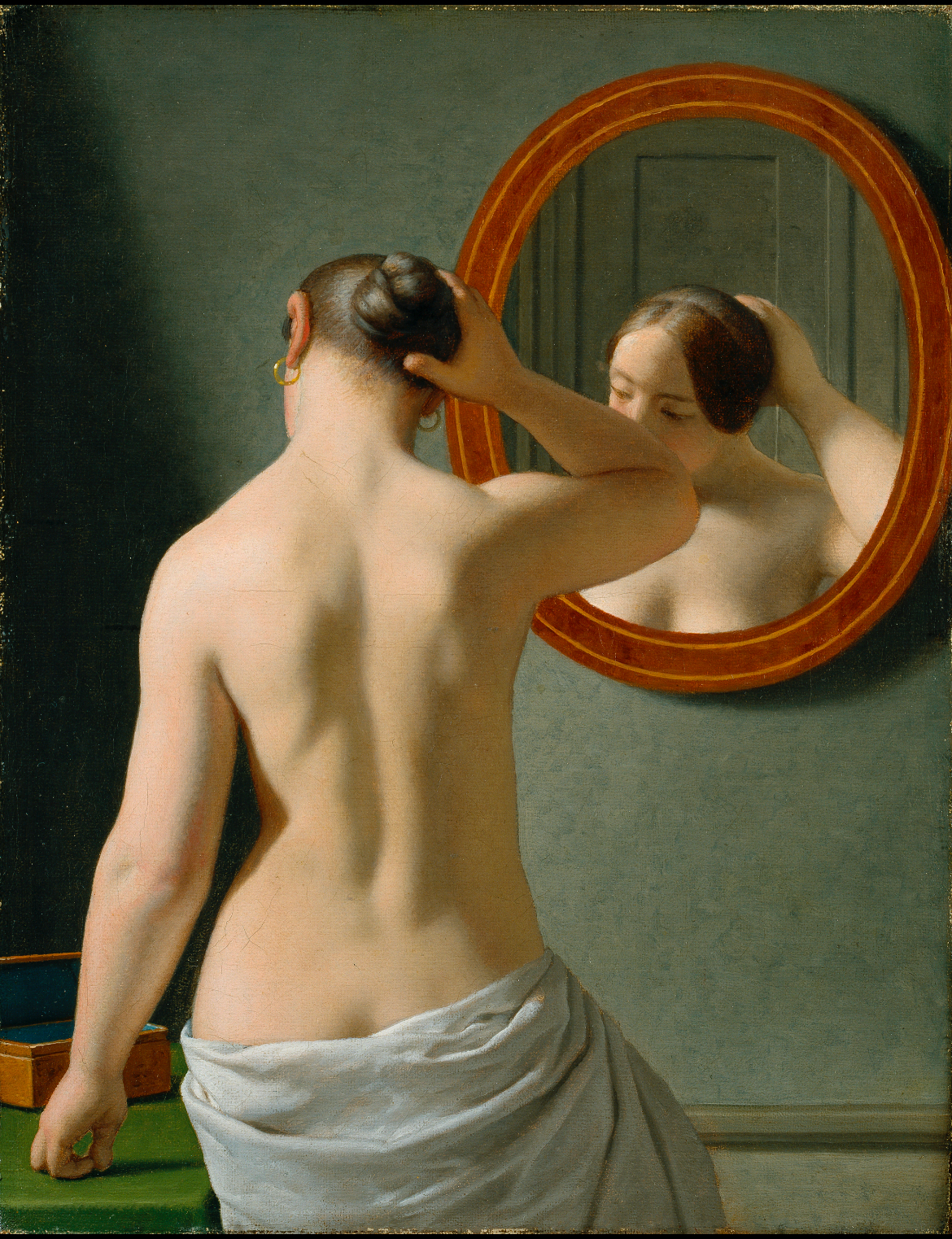
Kvinde foran et spejl
Even though the painting in this post is often referred to as A Nude Woman Doing Her Hair Before a Mirror, the original Danish title reads Woman in front of a mirror. It was made in 1841 when Eckersberg had returned to Copenhagen.
What we see in the painting is a woman, standing with her back towards us, in an intimate scene from daily life. And I must say, Eckersberg is covering her intimacy in quite interesting ways. First, we do not see the whole face of the woman; her elbow is hiding a large part of her expression in the mirror, and all we see is her eyes looking down at the table beside her. Second, the frame of the mirror is positioned exactly so as to cover her breasts, and what we see is perhaps nothing more than what would have been visible in a formal dining gown in the middle of the 19th century. And third, she has a cloth around her waist that is slightly pulled down but still covers her hips and bottom.
There is a kind of concealed eroticism in the painting, as it both hides and reviles, and in this painting—at least in my view—Eckersberg balanced this line exquisitely. In fact, there were (at least) two other painters present when Eckersberg made this masterpiece, namely Sally Henriques and Ludvig August Smith. These two made their own version of the scene, with slightly different characteristics. The composition is similar, although some details are different. In one of the paintings, a draped blanket hangs from the wall, and the mirror can be said to be playing a minor part in those other two paintings. Further, the use of colours is different, making Eckersberg’s version—again in my view—far the most pleasant. However, what mostly distinguishes Eckersberg’s painting from the two other versions is the fact that both Henriques and Smith reveal marginally more in their mirrors, most notably the woman’s face and more of the left breast. Of course, there are plenty of great paintings that—successfully—show intimate details of a woman’s body; still, in this case, not revealing these details adds to the mood and the quality of the painting. It is hard for a layman like myself to know if this was a matter of choice on Eckersberg’s part or if it was due to the trivial fact that Eckersberg was positioned differently from the other two artists and just painted what he saw. However, whatever the reason, the painting speaks for itself and conveys brilliantly this everyday scene.
What we get, then, is a peek into a woman doing her toilet, but at a point when her intimacies are not disclosed from the viewpoint of the artist. The woman could be anyone, as there is no mark on her that identifies her from someone else. For Eckersberg, though, this was not any woman. The model for this painting was Florentine, a model he had employed for several of his works. In her, Eckersberg had found a naturalised idealisation of the female body. This idealised nature points back to the ancient Greek ideals of beauty and how beauty was presented in earlier times. As such, the woman in the painting, her posture, and the cloth around her waist bear resemblance to the famous Greek sculpture Venus de Milo. The sculpture was made sometime between 150 and 125 BC, during the Hellenistic period. However, it was discovered as late as 1820 by a Greek farmer on the island of Milos. This was only about 20 years before Eckersberg’s painting, and the art world may have taken notice of this discovery.
Seen from behind, Venus de Milo has draped a cloth around herself in the same manner as the woman in the painting by Eckersberg, and their hair also is done in the same way. And further, even though Venus de Milo’s arms have not been recovered, it can be argued that Florentine in the painting is positioning her arms in accordance with what could be the case with Venus de Milo, effectively placing Venus herself in an everyday—and at the time contemporary—setting. These connections to the Roman goddess Venus, I think, elevate the woman in Eckersberg’s painting and mythologise her into something that is not everyday at all but rather divine. Venus, the goddess of love, beauty and fertility, is here rendered by Eckersberg in an understated way, making her features and abilities available in our own time.
I must say, I find this reference to classic Greek and Roman art fascinating. I feel the painting by Eckersberg speaks to me through the ages, and it makes Venus actually… well… come alive, in a way. The pureness of her body, her modest gaze at the box on the table, the light that falls on her from the outside, soothing the colours, and the stillness in the scene—all this brings life and detail to an imaginary Venus. I have to admit, I hardly noticed the painting the first time I saw it, but after spending some time just looking at it, it really starts to mean something.